
Notice:
Values are in US Dollars for direct import by the end consumer and are subject to import duties and customs duties.
(the amount can be paid in installments or financed - Find out here how to finance)
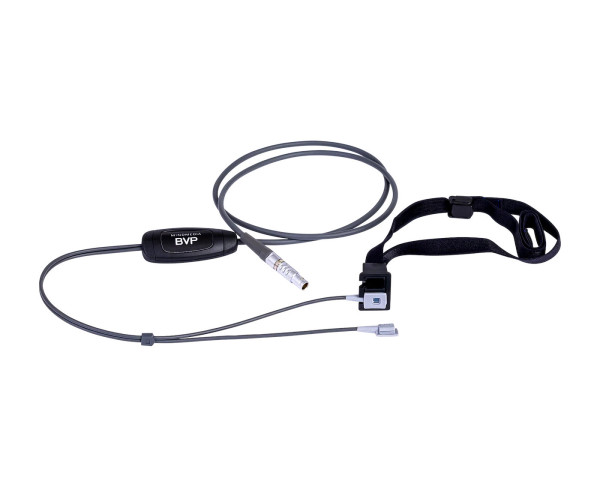
The Blood Volume Pulse (BVP) Sensor | Head, developed by Mind Media for the NeXus ecosystem, is a professional, non-invasive sensor designed to monitor relative changes in blood flow at the temporal artery, located on the side of the head.
Using optical Photoplethysmography (PPG) technology with near-infrared light, the sensor detects peripheral blood flow variations associated with cardiovascular activity. A flexible headband keeps the optical emitter and receiver properly positioned over the temporal artery during signal acquisition.
This configuration provides an alternative to finger-based BVP acquisition, making the sensor suitable for professional applications involving cardiovascular biofeedback, heart rate monitoring, HRV training, psychophysiology, and multimodal physiological acquisition.
PPG – Photoplethysmography Technology
The BVP Head Sensor uses Photoplethysmography (PPG), a non-invasive optical technology designed to detect relative changes in peripheral blood flow.
The measurement principle is based on the emission and detection of light in the monitored area. Changes in blood volume associated with cardiovascular activity modify the optical signal detected by the sensor, generating a waveform corresponding to variations in the blood pulse.
From the BVP signal, compatible NeXus systems can derive information related to cardiovascular activity, including heart rate and pulse amplitude.
Temporal Artery Acquisition
The main distinguishing feature of the BVP Sensor | Head is its acquisition location.
Instead of using a finger clip, as with the BVP Finger Sensor, the Head version positions the optical sensor over the temporal artery (Arteria Temporalis) on the side of the head.
The emitter and receiver are mounted on the headband, which is positioned horizontally around the head, typically above the ears, keeping the sensing components aligned with the temporal artery.
The headband should be adjusted to provide stable positioning without causing unnecessary pressure or discomfort.
Flexible and Adjustable Headband
To maintain proper sensor positioning during acquisition, the BVP Head uses a flexible headband.
The headband helps stabilize the optical components over the temporal region and can be adjusted according to the individual user.
This configuration facilitates BVP acquisition in protocols where head placement is more convenient or appropriate than finger-based monitoring.
Heart Rate Monitoring
The BVP signal can be used to obtain information related to Heart Rate (HR).
Periodic oscillations in the BVP waveform correspond to peripheral blood flow changes associated with cardiovascular activity. By detecting these pulse waves, compatible systems can calculate heart rate information.
BVP provides a convenient and efficient method for acquiring heart rate and relative blood flow information. For applications requiring greater temporal precision in cardiac measurements, particularly certain research protocols, ECG/EKG acquisition with an appropriate ExG Sensor may be considered.
Heart Rate Variability – HRV
The BVP signal can also be incorporated into applications involving Heart Rate Variability (HRV).
By analyzing variations in the timing between consecutive pulse waves, compatible systems can use BVP data in cardiovascular biofeedback and HRV training protocols.
The BVP Sensor can also be combined with respiration monitoring, allowing cardiovascular and respiratory changes to be observed simultaneously during HRV Training.
Relative Blood Flow Monitoring
In addition to heart rate information, BVP provides data related to relative changes in peripheral blood flow.
Changes in BVP waveform amplitude may accompany cardiovascular responses involving vasoconstriction and vasodilation of peripheral blood vessels.
This makes BVP a useful cardiovascular parameter for biofeedback and psychophysiological protocols, particularly when interpreted together with other physiological signals.
Non-Invasive Acquisition
One of the primary advantages of the BVP Head Sensor is its optical and non-invasive measurement method.
The system does not require adhesive electrodes to detect the blood pulse. Instead, PPG technology is used while the headband maintains the sensor components in position over the temporal region.
This provides a practical configuration for professional physiological acquisition and biofeedback sessions.
An Alternative to the BVP Finger Sensor
The BVP Head and BVP Finger sensors use the same general photoplethysmography principle but differ primarily in their acquisition location.
While the Finger version performs measurements at the index or middle finger, the Head version positions the optical assembly over the temporal artery.
This provides professionals with different BVP acquisition options depending on the protocol, user requirements, and overall sensor configuration.
Cardiovascular Biofeedback
The BVP Head Sensor can be incorporated into cardiovascular biofeedback protocols.
By converting blood pulse variations into measurable information that can be displayed in real time, the system allows users and professionals to monitor changes related to heart rhythm and relative peripheral blood flow.
Within compatible NeXus configurations, these physiological signals can be incorporated into biofeedback sessions and combined with other modalities.
Integration with Respiration for HRV Training
A particularly relevant BVP application is its combination with respiration monitoring.
While the BVP Sensor provides information related to cardiovascular pulse activity, a Respiration Sensor monitors inhalation and exhalation cycles.
Analyzing both signals together makes it possible to observe the relationship between breathing rhythm and heart rate variations, making this combination particularly useful for HRV Training protocols.
Psychophysiology and Multimodal Acquisition
The BVP Head Sensor can also be incorporated into psychophysiological protocols that combine multiple physiological signals.
Depending on the NeXus system and sensors being used, professionals can integrate BVP information with:
- RSP – respiration;
- GSR/EDA – electrodermal activity;
- TMP – peripheral temperature;
- EMG – muscle activity;
- ECG/EKG – cardiac electrical activity;
- EEG – brain activity.
This multimodal approach enables different dimensions of physiological activity to be monitored simultaneously.
Compatibility with NeXus Systems
The BVP Head Sensor is available in different versions according to the NeXus acquisition system being used.
The standard NeXus version, featuring a brushed metal ODU connector, is designed for compatible systems including:
- NeXus | 10;
- NeXus | Q24;
- NeXus | 4;
- NeXus | 32F.
For the NeXus | Q32, a dedicated version is available with a black plastic ODU connector.
Selecting the correct sensor version is important to ensure compatibility with the NeXus acquisition system.
Designed for Professional Use
In addition to the flexible headband, the standard NeXus version features a brushed metal connector designed for professional use and durability.
The combination of adjustable positioning, optical acquisition, and integration with the NeXus ecosystem makes the sensor suitable for recurring physiological monitoring, biofeedback, and research sessions.
Key Features
- Professional Blood Volume Pulse (BVP) Sensor;
- Optical PPG – Photoplethysmography technology;
- Uses near-infrared light;
- Non-invasive acquisition;
- Measurement over the temporal artery;
- Flexible and adjustable headband;
- Monitoring of relative blood flow changes;
- Provides information related to Heart Rate (HR);
- Suitable for Heart Rate Variability (HRV) applications;
- Monitoring of relative pulse amplitude;
- Information related to vasoconstriction and vasodilation;
- Can be combined with respiration monitoring for HRV Training;
- Brushed metal ODU connector on the standard NeXus version;
- Compatible with NeXus | 10, NeXus | Q24, NeXus | 4, and NeXus | 32F;
- Dedicated version available for NeXus | Q32.
Applications
The Blood Volume Pulse (BVP) Sensor | Head can be incorporated into applications involving:
- Cardiovascular biofeedback;
- HRV Training;
- Heart rate monitoring;
- Heart Rate Variability;
- Psychophysiology;
- Physiological self-regulation;
- Human performance;
- Behavioral research;
- Scientific research;
- Multimodal physiological acquisition.
Its temporal placement provides an alternative to finger-based acquisition while allowing cardiovascular information to be integrated into different professional protocols.
BVP Head as Part of a Psychophysiological Profile
When integrated with other NeXus sensors, the BVP Head Sensor can contribute to a broader analysis of physiological responses.
Cardiovascular information can be correlated with respiration, GSR/EDA, peripheral temperature, EMG, or EEG, depending on the acquisition system and protocol.
This multimodal approach makes it possible to monitor multiple physiological responses simultaneously within a single professional ecosystem.
Cardiovascular Monitoring with Head-Based Placement
The Blood Volume Pulse (BVP) Sensor | Head combines optical PPG technology, temporal artery positioning, and a flexible headband to provide a non-invasive solution for acquiring relative blood flow changes and cardiovascular information.
Its integration with compatible NeXus systems allows BVP to be incorporated into biofeedback, HRV, psychophysiology, human performance, and multimodal physiological acquisition protocols, providing a practical alternative to traditional finger-based BVP measurement.
Blood Volume Pulse (BVP) Sensor | Head — non-invasive PPG technology for cardiovascular acquisition and relative blood flow monitoring at the temporal artery.
The BVP Head Sensor for NeXus offers:
- An easy way to measure blood flow in the Arteria Temporalis
- A flexible head band
- A brushed metal connector for durability