
Notice:
Values are in US Dollars for direct import by the end consumer and are subject to import duties and customs duties.
(the amount can be paid in installments or financed - Find out here how to finance)
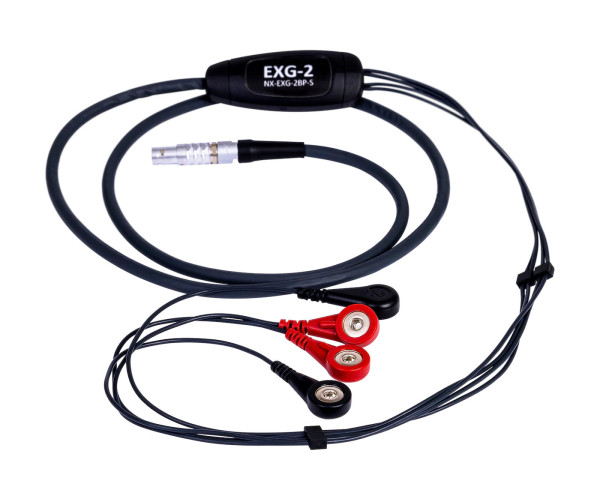
The NeXus ExG Sensor, developed by Mind Media, is a professional biopotential acquisition sensor designed to work with NeXus systems for biofeedback, neurofeedback, psychophysiology, and physiological signal acquisition applications.
Featuring a dual-channel bipolar configuration, the ExG Sensor can acquire different types of electrophysiological activity using a single sensor architecture. Depending on electrode placement and configuration, it can be used to record EEG (brain activity), sEMG (muscle activity), ECG/EKG (cardiac activity), and EOG (eye movement activity).
This versatility makes the ExG Sensor an important component within the NeXus ecosystem, allowing the same acquisition platform to be adapted to different professional and research protocols.
One Sensor, Multiple Biopotentials
One of the main advantages of the NeXus ExG Sensor is its flexibility.
The sensor is designed to acquire one or two bipolar channels and can be configured according to the type of electrophysiological signal being recorded.
Its main acquisition modalities include:
- EEG – Electroencephalography: recording of electrical brain activity;
- sEMG – Surface Electromyography: recording of electrical muscle activity;
- ECG/EKG – Electrocardiography: recording of cardiac electrical activity, supporting heart rate and HRV-related applications;
- EOG – Electrooculography: recording of electrical activity associated with eye movements.
This architecture allows the sensor to be incorporated into different biofeedback, neurofeedback, and psychophysiological acquisition configurations.
Dual-Channel Bipolar Configuration
The ExG Sensor uses a dual-channel bipolar configuration.
In the Snap-On version, the cable features two red positive connectors and two black negative connectors. Each channel uses its own positive and negative connection for bipolar signal acquisition.
This configuration makes it possible to record up to two channels simultaneously using a single ExG Sensor.
For applications requiring additional channels, compatible NeXus systems can use two ExG Sensors to acquire up to four EEG or sEMG channels, depending on the system and selected configuration.
sEMG – Muscle Activity
One of the primary applications of the ExG Sensor is surface electromyography (sEMG) acquisition.
With compatible electrodes positioned on the skin, the sensor can acquire electrical activity associated with muscle activation.
This modality can be incorporated into professional applications involving:
- Muscular biofeedback;
- Muscle control training;
- Muscle coordination;
- Relaxation training;
- Human performance;
- Rehabilitation;
- Research involving muscular activity.
The flexibility of the ExG Sensor makes it possible to incorporate muscle activity into both dedicated and multimodal physiological protocols.
EEG – Brain Activity
The ExG Sensor can also be configured for bipolar EEG acquisition.
In this configuration, electrodes acquire potential differences associated with electrical brain activity, allowing the sensor to be integrated into EEG and neurofeedback applications supported by compatible NeXus systems.
In addition to the Snap-On version, Mind Media offers a version with 1.5 mm Touch-Proof/DIN connectors, suitable for bipolar EEG measurements and compatible electrode configurations.
ECG/EKG – Cardiac Activity and HRV
Another important application is ECG/EKG acquisition.
When configured with appropriate electrodes, the ExG Sensor can record cardiac electrical activity, supporting applications involving heart rate and Heart Rate Variability (HRV).
ECG-based acquisition can provide precise cardiac timing information and can be incorporated into biofeedback, psychophysiological, performance, and research protocols.
EOG – Eye Movement Activity
The ExG Sensor can also be used for EOG – Electrooculography.
In this configuration, the system records electrical potential differences associated with eye movements, expanding the sensor's capabilities for psychophysiological and experimental protocols.
EOG can also complement other physiological modalities in research configurations where ocular activity needs to be recorded alongside EEG or other signals.
Shielded Cables for Improved Signal Quality
Signal quality is a fundamental aspect of NeXus sensor technology.
The ExG Sensor uses shielded cables that, in combination with the Active Shielding technology incorporated into compatible NeXus systems, help reduce 50/60 Hz electrical interference and artifacts caused by cable movement.
This is particularly important for low-amplitude electrophysiological signals, where environmental noise and movement can significantly affect recording quality.
Snap-On Connectors
In its Snap-On configuration, the ExG Sensor uses connectors compatible with different types of electrodes.
The connectors can be used with many self-adhesive ECG/EKG and EMG electrodes, as well as compatible disc electrodes used for EEG acquisition.
This flexibility allows professionals to select electrodes according to the physiological modality and requirements of the protocol.
Touch-Proof / DIN Version
In addition to the Snap-On configuration, the ExG Sensor is available with standard 1.5 mm Touch-Proof/DIN connectors.
This version features two red and two black connectors and is particularly suitable for bipolar EEG configurations and other applications using accessories compatible with the Touch-Proof standard.
The availability of different connector options allows the sensor to be adapted to different electrode systems and professional workflows.
Ground Cable Requirement
When acquiring electrophysiological signals with the ExG Sensor, a compatible Ground Cable is also required.
The ground connection contributes to stable biopotential acquisition and helps the system manage electrical interference during recording.
Correct electrode placement, ground connection, and sensor configuration are important for obtaining consistent physiological signals.
Compatibility with NeXus Systems
The ExG Sensor is available in specific configurations for different devices within the NeXus ecosystem.
The version with a 6-pin metal connector is designed for compatible systems such as:
- NeXus | 10;
- NeXus | Q24;
- NeXus | 4;
- NeXus | 32F.
For the NeXus | Q32, a specific version using a black plastic ODU connector is available.
Because connector and sensor configurations can vary between NeXus platforms, the appropriate ExG Sensor version should always be selected according to the acquisition system being used.
Key Features
- Professional ExG biopotential acquisition sensor;
- 2 channels per sensor;
- Acquisition of one or two bipolar channels;
- Compatible with EEG applications;
- Compatible with sEMG acquisition;
- Compatible with ECG/EKG acquisition;
- Compatible with EOG acquisition;
- Support for heart rate and ECG-based HRV applications;
- Bipolar acquisition configuration;
- Shielded cables;
- Integration with Active Shielding technology on compatible NeXus systems;
- Reduced 50/60 Hz electrical interference;
- Reduced artifacts associated with cable movement;
- Snap-On and 1.5 mm Touch-Proof/DIN versions;
- Compatibility with different electrode types;
- Ability to combine two sensors for up to four EEG or sEMG channels on compatible systems;
- Specific versions for different NeXus platforms;
- Designed for use with a compatible Ground Cable.
Applications
The NeXus ExG Sensor can be incorporated into applications including:
- Biofeedback;
- Neurofeedback;
- Bipolar EEG;
- sEMG;
- Muscular biofeedback;
- ECG/EKG;
- ECG-based HRV;
- EOG;
- Psychophysiology;
- Multimodal physiological signal acquisition;
- Human performance training;
- Rehabilitation;
- Scientific research;
- Behavioral sciences.
Versatility for Biofeedback and Neurofeedback
The key advantage of the NeXus ExG Sensor is the ability to use the same sensor architecture for multiple electrophysiological signals.
For muscular biofeedback, it can be configured for sEMG. For neurofeedback or brain activity acquisition, it can be used for bipolar EEG. In cardiovascular protocols, it can acquire ECG, while specific psychophysiological applications can use EOG.
This flexibility expands the capabilities of compatible NeXus systems and allows professionals to configure different physiological protocols using a consistent sensor ecosystem.
Signal Quality Integrated into the NeXus Ecosystem
The NeXus ExG Sensor combines dual-channel bipolar acquisition, shielded cables, and integration with the interference-reduction technologies of the NeXus platform.
Its ability to work with EEG, sEMG, ECG/EKG, and EOG makes it a versatile solution for professionals who need to configure different electrophysiological acquisition protocols within the Mind Media ecosystem.
Compact in concept yet highly versatile in application, the ExG Sensor connects multiple biopotential modalities to a professional physiological acquisition platform.
NeXus ExG Sensor — versatility, signal quality, and bipolar acquisition for EEG, sEMG, ECG, and EOG.
Contact our team for more information about versions, connectors, electrodes, Ground Cables, NeXus system compatibility, and commercial conditions.
The dual channel ExG Sensor cable has a sturdy brushed metal connector for connecting to your NeXus-10. The shielded cables In combination with the NeXus active shielding technology significantly reduce 50/60 Hz noise and movement artifacts. Please note that when recording electrophysiological signals (biopotentials) you always need to also connect the ground reference cable.
The EXG Sensor uses the 6 pin brushed metal connector for the NeXus | 10, the NeXus | Q24 and the NeXus 4 and NeXus 32F.
NeXus-Q32 - for this system the sensor uses a black plastic ODU connector to connect to the unit. Please note that the Q32 Sensors and cables can only be used on the NeXus-Q32.