
Notice:
Values are in US Dollars for direct import by the end consumer and are subject to import duties and customs duties.
(the amount can be paid in installments or financed - (Find out here how to finance)
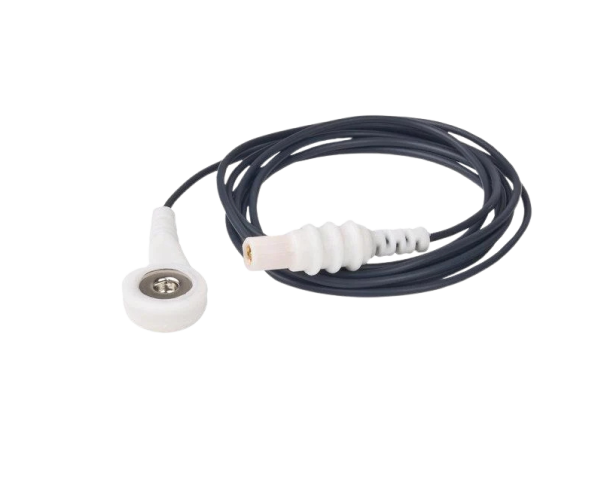
The Ground Cable, developed by Mind Media for the NeXus ecosystem, is an essential accessory for the acquisition of electrophysiological signals such as EEG, EMG, ECG, EOG, and Slow Cortical Potentials (SCP).
During the recording of these biopotentials, the acquisition system requires a ground connection to support proper and stable electrophysiological signal acquisition. The Ground Cable integrates with compatible ExG Sensors, EEG Linked Ear Sensors, and SCP Sensors, making it an important component of professional NeXus measurement configurations.
Ground Connection for Electrophysiological Acquisition
Signals such as EEG, EMG, ECG, and EOG have relatively small electrical amplitudes and require appropriate electrode and reference configurations.
The Ground Cable provides the ground connection required by the acquisition system during these recordings.
According to Mind Media, only one ground connection is required when recording electrophysiological signals such as EEG, EMG, ECG, EOG, or SCP.
EEG Applications
In EEG and neurofeedback configurations, the Ground Cable is used together with compatible EEG sensors.
It can complement configurations using EEG Linked Ear Sensors, ExG Sensors configured for EEG acquisition, and dedicated Slow Cortical Potentials sensors.
The ground connection forms part of the electrical configuration required for proper acquisition of brain electrical activity with compatible NeXus systems.
EMG Applications
The Ground Cable is also used in Electromyography (EMG) protocols.
When combined with an ExG Sensor configured for muscle activity acquisition, the cable provides the ground connection required to complete the electrophysiological setup.
This configuration can be incorporated into muscular biofeedback, motor control, human performance, and physiological acquisition protocols.
ECG and EOG Applications
The same principle applies to ECG/EKG and EOG recordings.
In ECG-based cardiovascular protocols, the Ground Cable complements the electrode configuration used to record cardiac electrical activity.
For EOG applications, it forms part of the setup used to acquire electrical potential changes associated with eye movements.
This allows the same accessory to support multiple electrophysiological modalities within the NeXus ecosystem.
Slow Cortical Potentials – SCP
The Ground Cable can also be used in configurations involving the Slow Cortical Potentials Sensor | SCP.
This expands its application to protocols involving slow cortical potential acquisition and specific neurofeedback methodologies.
The ground connection helps complete the electrophysiological configuration required for these measurements.
Integration with the ExG Sensor
The ExG Sensor is one of the primary sensors used together with the Ground Cable.
Depending on the protocol, an ExG Sensor can be configured for EEG, EMG, ECG, or EOG, while the Ground Cable provides the common ground connection required for acquisition.
This makes the Ground Cable a versatile accessory for different electrophysiological applications within the NeXus platform.
Integration with EEG Linked Ear Sensors
The Ground Cable also forms part of EEG configurations using linked-ear referencing.
While EEG Linked Ear Sensors provide the active EEG channels and shared reference connections at the ears or mastoids, the Ground Cable provides the ground connection required by the acquisition system.
This architecture enables dedicated EEG and neurofeedback configurations according to the requirements of the selected protocol.
NeXus Version
Mind Media offers a standard Ground Cable version designed for compatible systems including:
- NeXus | 10;
- NeXus | Q24;
- NeXus | 4;
- NeXus | 32F.
This version uses an aluminum ODU connector for connection to the compatible NeXus acquisition system.
Snap-On Connection
The standard NeXus Ground Cable is available with a Snap-On connection.
This format allows compatible electrodes to be connected directly to the cable, providing a straightforward and practical setup for different electrophysiological protocols.
Snap-On connectivity also facilitates quick electrode replacement and session preparation.
TP/DIN Version
For certain NeXus configurations, the Ground Cable is also available with a TP/DIN connection.
When Snap-On electrodes need to be used with this configuration, a compatible TP/DIN to Snap-On adapter cable may be required.
This provides additional flexibility for different electrode and accessory configurations.
Dedicated Version for NeXus | Q32
The NeXus | Q32 uses a dedicated version of the Ground Cable.
This version features a black plastic ODU connector and is available with a Snap-On connection.
As with other Q32-specific sensors and accessories, selecting the correct Ground Cable version is important to ensure compatibility with the acquisition system.
Key Features
- Professional ground cable for NeXus systems;
- Essential for electrophysiological signal acquisition;
- Suitable for EEG, EMG, ECG, EOG, and SCP protocols;
- Only one ground connection is required per acquisition setup;
- Integration with the ExG Sensor;
- Integration with EEG Linked Ear Sensors;
- Integration with Slow Cortical Potentials Sensor | SCP;
- Standard NeXus version compatible with NeXus | 10, Q24, 4, and 32F;
- Aluminum ODU connector on the standard NeXus version;
- Available with Snap-On connection;
- TP/DIN version available for compatible configurations;
- TP/DIN configurations can use an adapter for Snap-On electrodes;
- Dedicated version available for NeXus | Q32;
- Black plastic ODU connector on the Q32 version;
- Q32 version available with Snap-On connectivity.
Applications
The Ground Cable can be incorporated into configurations involving:
- EEG;
- Neurofeedback;
- EMG;
- Muscular biofeedback;
- ECG/EKG;
- EOG;
- Slow Cortical Potentials (SCP);
- Psychophysiology;
- Neurophysiological research;
- Multimodal physiological acquisition.
Its primary role is to complement compatible electrophysiological sensors by providing the ground connection required for signal acquisition.
An Essential Accessory for ExG Systems
Although it is a relatively simple component, the Ground Cable performs an essential function in electrophysiological configurations using NeXus systems.
Sensors designed for EEG, EMG, ECG, EOG, and SCP acquisition depend on an appropriate electrical configuration. The Ground Cable provides the common ground connection required by these protocols.
With versions designed for different NeXus platforms and electrode connection standards, it can be incorporated into a variety of professional acquisition configurations.
Compatibility and Configuration
Before selecting a Ground Cable, it is important to verify the NeXus system model and connector standard being used.
For NeXus | 10, Q24, 4, and 32F systems, the corresponding standard NeXus version should be selected. For the NeXus | Q32, the dedicated version with the black ODU connector is required.
The electrode connection type should also be considered, including Snap-On or TP/DIN, to ensure compatibility with the electrodes and accessories used in the protocol.
Ground Connection for Professional Electrophysiological Acquisition
The Ground Cable is a fundamental component of the NeXus ecosystem for protocols involving biopotential acquisition.
Compatible with multiple sensors and available in versions for different NeXus platforms, it provides the ground connection required for EEG, EMG, ECG, EOG, and SCP recordings.
Its integration with ExG Sensors, EEG Linked Ear Sensors, and SCP Sensors makes it possible to complete a wide range of professional biofeedback, neurofeedback, psychophysiology, and electrophysiological acquisition configurations.
Ground Cable — essential ground connectivity for reliable electrophysiological acquisition within the NeXus ecosystem.
Contact our team for more information about NeXus and Q32 versions, Snap-On or TP/DIN connections, electrode and sensor compatibility, configuration, accessories, and commercial conditions.