
Notice:
Values are in US Dollars for direct import by the end consumer and are subject to import duties and customs duties.
(the amount can be paid in installments or financed – Find out here how to finance)
Combining inertial reflex sensors, algorithms and biomechanics, GaitUP GO solutions clinically validated motion analytics covering all major gait and balance tests. Giving wearables the precision of motion labs, it delivers the need for everyday clinical use through a simple app.
Currently deployed throughout the world in major centers that work with patients who care for stroke, Parkinson's disease and multiple sclerosis, most tests are performed under direct supervision. However, some can be performed independently with the data available for further analysis. It also tests which makes it ideal for use in geriatrics (eg adults living at home), orthopedics (eg arthrosis and knee arthroplasty) and sports medicine.
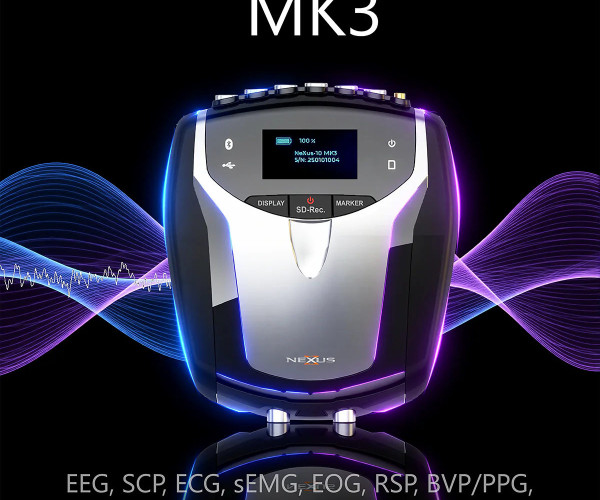
The NeXus | 10 MK3 is the successor to the trusted MKII, bringing next-generation multimodal data acquisition with enhanced flexibility, portability, and high-fidelity recording for clinical practice, research, education, and performance coaching. Built on proven reliability and evolved for mobility, the MK3 introduces meaningful improvements ready for tomorrow’s applications.
It provides up to 4-channel ExG for measuring brain activity (EEG), muscle activity (EMG), or cardiac activity (ECG), combined with 4 auxiliary inputs for additional signals like heart rate variability, galvanic skin response (GSR), respiration, temperature, blood flow, and more. It also includes inputs for triggers, digital sensors, and expanded digital I/O for advanced synchronization in research and education workflows.
The NeXus | 10 MK3, developed by Mind Media, is a next-generation multimodal platform for physiological signal acquisition and recording, designed for professional applications in biofeedback, neurofeedback, psychophysiology, research, performance training, and rehabilitation.
Built on the established NeXus platform, the MK3 combines flexibility, mobility, and high-fidelity physiological signal acquisition in a single system, enabling the simultaneous recording of different parameters related to brain, muscle, cardiac, and autonomic activity.
With 4 ExG channels and 4 auxiliary inputs, Bluetooth Low Energy wireless connectivity, USB-C, SD card recording, and battery life of up to 32 hours, the NeXus | 10 MK3 provides a versatile platform for professionals who require physiological assessment and training capabilities in both controlled and mobile environments.
Multimodal Physiological Signal Acquisition
One of the key advantages of the NeXus | 10 MK3 is its ability to integrate multiple acquisition modalities into a single device.
The four ExG channels can be used to record signals related to:
- EEG – Electroencephalography: electrical brain activity;
- EMG – Electromyography: muscle activity;
- ECG – Electrocardiography: cardiac activity;
- SCP – Slow Cortical Potentials: slow changes in cortical electrical activity.
In addition, the four auxiliary inputs support compatible sensors for physiological parameters such as skin conductance (GSR/EDA), respiration, temperature, heart rate, pulse/PPG, blood flow, and other peripheral physiological signals.
EEG and Neurofeedback
The NeXus | 10 MK3 provides up to 4 ExG channels that can be configured for EEG acquisition and neurofeedback-related applications.
This generation features an expanded DC/EEG input range of approximately ±180,000 µV, increasing flexibility for applications involving different electrode technologies and slow cortical potential recordings.
This architecture makes the system a versatile platform for professionals and researchers working with neurophysiological signal acquisition.
EMG and Muscle Activity
The ExG channels can also be configured for electromyography (EMG) acquisition.
Recording electrical muscle activity expands the system's capabilities for applications involving muscular biofeedback, performance training, motor control, and rehabilitation.
The ability to combine EMG with other physiological signals allows professionals to observe multiple physiological responses simultaneously within the same session.
ECG and Cardiovascular Responses
The NeXus | 10 MK3 also supports ECG acquisition, enabling cardiac activity to be integrated with other physiological modalities.
With additional compatible sensors, the system can incorporate parameters related to heart rate and pulse, enabling multimodal configurations in which cardiovascular, muscular, cerebral, and autonomic responses can be recorded simultaneously.
Autonomic Response Monitoring
The 4 auxiliary inputs significantly expand the capabilities of the NeXus | 10 MK3.
Depending on the sensors used, the system can acquire parameters such as:
- Skin conductance (GSR/EDA);
- Respiration (RSP);
- Temperature (TMP);
- Pulse and blood volume (PPG/BVP);
- Heart rate;
- Blood flow;
- Other compatible peripheral physiological signals.
With the MK3, Mind Media has increased the resolution of the auxiliary inputs by approximately 1.5 to 2 times and increased their sampling rate to 512 Hz, supporting the detection of more subtle changes in autonomic signals.
High-Fidelity Signal Acquisition
Signal quality is one of the core principles of the NeXus platform.
Mind Media uses technologies such as active shielding, carbon-coated cables, shielded sensors, and high-quality electronics to help minimize noise and artifacts during physiological signal acquisition.
The NeXus | 10 MK3 also incorporates artifact-management capabilities and improvements in data resolution and acquisition, supporting consistent signal quality across different physiological modalities.
Bluetooth Low Energy – Greater Freedom During Sessions
One of the major developments introduced with the MK3 is Bluetooth Low Energy (BLE) connectivity.
This technology provides greater wireless communication flexibility and is particularly useful for mobile sessions, reducing dependence on cables between the device and computer.
This feature expands the system's potential for applications where freedom of movement and user mobility are important.
Up to 32 Hours of Battery Life
The NeXus | 10 MK3 provides up to 32 hours of battery life, enabling extended sessions and different recording protocols without frequent recharging.
Combined with Bluetooth connectivity and SD card recording, this extended battery life makes the system particularly suitable for mobile applications and prolonged physiological recordings.
USB-C and Offline Recording
In addition to wireless communication, the MK3 incorporates USB-C connectivity, providing an alternative for stable data transfer and device communication.
The system also features improved SD card recording, allowing physiological data to be recorded offline and retrieved later.
Professionals can therefore choose between real-time wireless communication, physical connectivity, or independent recording depending on the requirements of each protocol.
NIRS Support
Another addition to the NeXus | 10 MK3 is support for 2-channel NIRS (Near-Infrared Spectroscopy).
With the appropriate configuration and compatible sensors, this capability expands the platform for applications involving cerebral oxygenation, blood flow, and hemoglobin-related measurements.
NIRS support further expands the multimodal concept of the NeXus platform by adding another category of physiological information alongside traditional ExG and peripheral signals.
Integration with BioTrace+
The NeXus | 10 MK3 works together with BioTrace+, Mind Media's software platform for physiological signal visualization, storage, and controlled processing.
The software environment is customizable, allowing professionals to organize different acquisition configurations according to the physiological signals and objectives of each session.
Mind Media also positions the MK3 as a platform prepared for future developments within the BioTrace+ ecosystem, allowing the system to evolve alongside new software and sensor technologies.
BioTrace+ is not intended for medical diagnosis, vital-sign monitoring, or life-support applications. Physiological data should be interpreted by appropriately qualified professionals.
Synchronization and Integration with Other Systems
The MK3 incorporates trigger input capabilities and expanded digital I/O, including TTL and Serial, creating possibilities for synchronization with events, stimuli, and external equipment.
The system also includes a dedicated port for intelligent digital sensors.
According to the manufacturer's current information, certain advanced trigger, software, and interface capabilities are expected to receive full support in 2027, which should be considered when planning projects that depend on these specific features.
Key Features
- Multimodal physiological acquisition platform;
- 4 ExG channels configurable for EEG, EMG, or ECG;
- Support for Slow Cortical Potentials (SCP);
- 4 auxiliary inputs for peripheral physiological signals;
- Compatible with GSR/EDA, respiration, temperature, PPG/BVP, and other sensors;
- Expanded DC/EEG range of approximately ±180,000 µV;
- Improved AUX input resolution;
- AUX sampling rate of up to 512 Hz;
- Bluetooth Low Energy (BLE) connectivity;
- USB-C connectivity;
- Offline recording via SD card;
- Battery life of up to 32 hours;
- Support for 2-channel NIRS;
- Dedicated trigger input;
- Expanded digital I/O with TTL and Serial;
- Dedicated digital sensor port;
- High-fidelity acquisition with artifact-management technologies;
- Integration with BioTrace+ software.
Applications
The NeXus | 10 MK3 can be used in professional applications including:
- Biofeedback;
- Neurofeedback;
- Psychophysiology;
- Scientific research;
- Behavioral sciences;
- Performance training;
- Performance coaching;
- Rehabilitation;
- EEG acquisition;
- EMG acquisition;
- ECG acquisition;
- Autonomic response monitoring;
- Multimodal physiological signal studies;
- Professional education and training.
Designed for Professional and Scientific Environments
The versatility of the NeXus | 10 MK3 makes it suitable for professionals who need to combine different physiological signals within a single protocol.
In neurofeedback, the ExG channels can be configured for EEG. In biofeedback, compatible sensors can be used to monitor muscular, cardiovascular, respiratory, thermal, and electrodermal responses.
In research and psychophysiology, its multimodal architecture enables simultaneous recording of different physiological responses, while connectivity and synchronization capabilities expand its potential for integration with other experimental systems.
Mobility Without Compromising Signal Quality
The NeXus | 10 MK3 is designed to combine multimodal physiological acquisition with greater operational freedom.
Bluetooth Low Energy, extended battery life, SD card recording, and USB-C connectivity provide multiple operating options, allowing the system to adapt to both conventional sessions and applications requiring greater mobility.
At the same time, its high-fidelity acquisition architecture maintains a strong focus on physiological signal quality and consistency.
A Platform for the Next Generation of Biofeedback and Neurofeedback
The NeXus | 10 MK3 represents the evolution of the NeXus platform toward a new generation of multimodal physiological acquisition.
By integrating EEG, EMG, ECG, and autonomic signals with modern connectivity, storage, and expansion capabilities, the system provides a flexible solution for professionals working in biofeedback, neurofeedback, psychophysiology, performance, rehabilitation, and research.
More than a physiological acquisition device, the NeXus | 10 MK3 provides a multimodal platform capable of bringing multiple dimensions of human physiology together within a single ecosystem.
NeXus | 10 MK3 — high fidelity, mobility, and multimodal acquisition for the next generation of biofeedback, neurofeedback, and psychophysiological research.
Contact our team for more information about configurations, sensors, accessories, software, compatibility, and commercial conditions.