
Notice:
Values are in US Dollars for direct import by the end consumer and are subject to import duties and customs duties.
(the amount can be paid in installments or financed - Find out here how to finance)
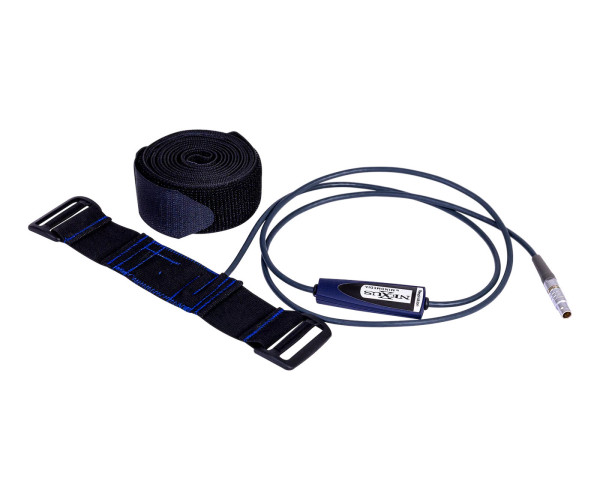
The Respiration (RSP) Sensor, developed by Mind Media for the NeXus ecosystem, is a professional sensor designed to acquire information related to breathing patterns, enabling the monitoring of respiratory rate and relative changes in the depth of abdominal or thoracic breathing.
Using an adjustable elastic belt positioned around the torso, the sensor detects circumference changes produced by respiratory movements. These variations are converted into signals that can be recorded and analyzed by compatible NeXus systems, providing a practical solution for applications involving respiratory biofeedback, psychophysiology, HRV training, human performance, and research.
Breathing Pattern Monitoring
The primary purpose of the RSP Sensor is to monitor changes produced during the inhalation and exhalation cycle.
During breathing, movements of the chest or abdomen change the tension applied to the elastic belt. The sensor detects these variations and generates a signal corresponding to the relative expansion observed during each respiratory cycle.
From this signal, the system can calculate respiratory rate in breaths per minute, enabling changes in breathing rhythm to be monitored throughout a session.
Respiratory Rate and Relative Breathing Depth
The Respiration Sensor can monitor both respiratory rate and the relative depth of abdominal or thoracic breathing.
It is important to note that the sensor does not provide an absolute volumetric measurement of inhaled or exhaled air. Signal amplitude primarily represents the relative expansion changes detected by the belt.
Because belt positioning and tension can vary between users and sessions, absolute amplitude values should not be interpreted as directly comparable respiratory volumes. Respiratory rate, however, can provide a consistent parameter for monitoring breathing patterns.
Respiratory Movement Detection Technology
The sensor operates using a mechanism based on a magnet and Hall-effect sensor, which detects changes associated with stretching of the belt during respiratory movements.
As the chest or abdomen expands and contracts, the sensor records these changes and generates raw data corresponding to the movement of the belt.
This technology provides a non-invasive method for continuously monitoring breathing behavior throughout a session.
Abdominal or Thoracic Breathing
The sensor can be used to monitor abdominal or thoracic breathing movements.
The Respiration Sensor is commonly positioned around the abdominal region. Depending on the objectives of the protocol, however, it can be positioned to monitor respiratory changes associated with either abdominal or thoracic expansion.
This flexibility allows the sensor to be incorporated into different respiratory training and psychophysiological acquisition protocols.
Adjustable Elastic Belt
To accommodate different users, the RSP Sensor includes two adjustable elastic belts, available in small and large sizes.
The attachment system is designed for convenient positioning and can be used over clothing, reducing the need for direct skin contact.
This makes session preparation simple and efficient, particularly in professional environments where multiple assessments or training sessions are performed throughout the day.
Respiratory Biofeedback
Breathing is a physiological parameter frequently incorporated into biofeedback protocols.
By transforming respiratory movements into measurable information, the RSP Sensor enables changes in breathing rhythm to be monitored during a session and integrated into the physiological acquisition environment of compatible NeXus systems.
This information can be incorporated into protocols designed to develop awareness and voluntary control of breathing patterns.
Integration with HRV Training
An important application highlighted by the manufacturer is the combination of the Respiration Sensor with the Blood Volume Pulse (BVP) Sensor for HRV Training.
By simultaneously recording respiration and peripheral cardiovascular activity, the system can help visualize the temporal relationship between respiratory cycles and changes in heart rate.
This combination is particularly useful for protocols exploring the interaction between breathing and Heart Rate Variability (HRV).
Multimodal Psychophysiological Applications
One of the advantages of the NeXus ecosystem is the ability to combine multiple physiological signals within the same session.
The RSP Sensor can be incorporated into configurations that include parameters such as EEG, EMG, ECG, BVP, GSR/EDA, and temperature, depending on the NeXus system and sensors being used.
This multimodal approach allows breathing patterns to be correlated with other physiological responses in biofeedback, human performance, psychophysiology, and research applications.
Shielded Cables and Artifact Reduction
The Respiration Sensor uses shielded cables designed to help minimize noise and movement-related artifacts during acquisition.
This contributes to more consistent respiratory signal acquisition, particularly when the sensor is combined with other physiological modalities in multimodal protocols.
Compatibility with NeXus Systems
The Respiration (RSP) Sensor is available in different versions according to the NeXus system being used.
The standard NeXus version, equipped with an aluminum ODU connector, is designed for compatible systems including:
- NeXus | 10;
- NeXus | Q24;
- NeXus | 4;
- NeXus | 32F.
For the NeXus | Q32, a dedicated version is available with a black plastic ODU connector.
Selecting the appropriate sensor version according to the NeXus acquisition platform is important to ensure proper compatibility.
Integration with BioTrace+
When used with a compatible NeXus system, respiratory signals can be recorded and monitored through the BioTrace+ software environment.
The platform allows breathing data to be incorporated into sessions involving different physiological parameters and biofeedback modalities.
This integration provides professionals with a flexible environment for monitoring respiratory patterns individually or as part of broader multimodal physiological protocols.
Key Features
- Professional sensor for breathing pattern acquisition;
- Monitoring of respiratory rate;
- Monitoring of relative breathing depth;
- Suitable for abdominal or thoracic breathing;
- Detection mechanism based on a magnet and Hall-effect sensor;
- Non-invasive measurement method;
- Adjustable elastic belt;
- Includes small and large belt sizes;
- Can be worn over clothing;
- Shielded cables designed to minimize noise and movement artifacts;
- Suitable for respiratory biofeedback;
- Can be combined with BVP for HRV Training;
- Integration with compatible NeXus systems;
- Dedicated version available for NeXus | Q32;
- Integration with the BioTrace+ ecosystem.
Applications
The Respiration (RSP) Sensor can be incorporated into applications involving:
- Respiratory biofeedback;
- Breathing training;
- HRV Training;
- Psychophysiology;
- Physiological signal acquisition;
- Multimodal biofeedback;
- Human performance training;
- Sports applications;
- Coaching;
- Scientific research;
- Behavioral research.
Its ability to continuously monitor breathing patterns also makes it possible to correlate respiratory changes with other physiological signals recorded simultaneously by compatible NeXus systems.
Respiration and BVP in an Integrated Approach
The combination of RSP and BVP is one of the key applications highlighted for the sensor.
While the RSP Sensor monitors respiratory cycles, a BVP sensor provides information related to peripheral pulse activity. When analyzed together, these signals can be particularly useful for HRV Training protocols exploring the relationship between breathing and cardiovascular activity.
This capability demonstrates how the RSP Sensor can function not only as an individual respiration sensor but also as part of a broader multimodal physiological acquisition platform.
Simple and Effective Professional Respiratory Acquisition
The Respiration (RSP) Sensor combines a non-invasive acquisition method, adjustable belts, the ability to be worn over clothing, and integration with compatible NeXus systems.
By transforming abdominal or thoracic expansion into physiological data that can be monitored throughout a session, the sensor provides professionals with a practical solution for incorporating respiration into biofeedback, HRV, psychophysiology, human performance, and research protocols.
Respiration (RSP) Sensor — simple, non-invasive respiratory monitoring integrated into the NeXus ecosystem for biofeedback, HRV training, and psychophysiological acquisition.
Contact our team for more information about available versions, NeXus system compatibility, configuration, BioTrace+, accessories, and commercial conditions.
The Respiration Sensor for NeXus offers:
- Two adjustable elastic straps; small and large
- Easy strap system and can easily be worn over clothing
- Shielded cables for a minimum of noise and movement-artifacts