
Notice:
Values are in US Dollars for direct import by the end consumer and are subject to import duties and customs duties.
(the amount can be paid in installments or financed – Find out here how to finance)
Combining inertial reflex sensors, algorithms and biomechanics, GaitUP GO solutions clinically validated motion analytics covering all major gait and balance tests. Giving wearables the precision of motion labs, it delivers the need for everyday clinical use through a simple app.
Currently deployed throughout the world in major centers that work with patients who care for stroke, Parkinson's disease and multiple sclerosis, most tests are performed under direct supervision. However, some can be performed independently with the data available for further analysis. It also tests which makes it ideal for use in geriatrics (eg adults living at home), orthopedics (eg arthrosis and knee arthroplasty) and sports medicine.
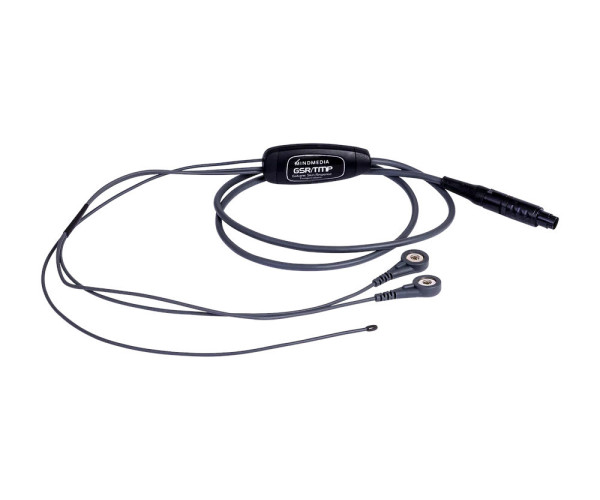
The Skin Conductance (GSR) & Temperature (TMP) Combi Sensor for Q32, developed by Mind Media, is a professional physiological sensor specifically designed for the NeXus | Q32, combining simultaneous acquisition of Skin Conductance (GSR/EDA) and Peripheral Temperature (TMP) in a single solution.
By integrating two physiological modalities into one sensor, it enables the monitoring of both changes in sweat gland activity and subtle variations in peripheral temperature, providing complementary information related to autonomic nervous system activity and physiological arousal.
Two Physiological Modalities in One Sensor
The main advantage of the Combi Sensor is the integration of Skin Conductance and Temperature measurements into a single device.
The GSR section monitors changes in the electrical conductance of the skin associated with sweat gland activity, while the TMP section monitors small changes in peripheral temperature.
Together, these two signals provide complementary physiological information commonly used in biofeedback, psychophysiology, and physiological monitoring, while simplifying the sensor configuration of the NeXus | Q32.
Skin Conductance – GSR / EDA
Skin Conductance (SC), also known as Galvanic Skin Response (GSR) or Electrodermal Activity (EDA), reflects changes in the electrical conductivity of the skin primarily associated with sweat gland activity.
The sensor performs this measurement using electrodes positioned on the fingers or palm of the hand. For typical Skin Conductance acquisition, the electrodes are commonly placed on the fingers of the non-dominant hand.
Changes in skin conductance can then be monitored throughout the physiological acquisition or biofeedback session.
Sweat Gland Activity
Sweat gland activity is controlled by the sympathetic nervous system and is closely associated with changes in physiological arousal.
Even subtle changes in sweat gland activity can modify the electrical conductance of the skin.
The GSR component detects these variations, allowing changes in electrodermal activity to be monitored during different tasks, stimuli, training exercises, or physiological conditions.
Measurement in MicroSiemens
Skin Conductance is expressed in microSiemens (µS).
The sensor is designed to detect very small relative changes in electrodermal activity, with sensitivity to variations down to 0.001 µS.
This level of sensitivity enables subtle changes in Skin Conductance to be monitored throughout a session.
Temperature – TMP
In addition to Skin Conductance, the Combi Sensor incorporates a peripheral temperature sensor.
This component is designed to monitor small temperature changes at the body's extremities, allowing temperature information to be displayed in degrees Celsius or Fahrenheit.
As a result, a single sensor provides simultaneous access to electrodermal and thermal physiological information.
High Temperature Sensitivity
The TMP component is designed to detect temperature changes down to 0.001 degree.
This sensitivity makes it possible to monitor subtle peripheral thermal variations during a session, providing an additional physiological parameter for biofeedback and psychophysiological acquisition.
Peripheral Temperature and Vasoconstriction
Temperature at the body's extremities can change in response to variations in peripheral circulation.
Increased sympathetic nervous system activity and physiological arousal may be associated with peripheral vasoconstriction, which can contribute to changes in peripheral temperature.
The TMP component enables these subtle thermal variations to be monitored and analyzed alongside other physiological parameters.
GSR and TMP as Complementary Measurements
The combination of GSR and temperature is particularly valuable because both modalities provide different but complementary information about peripheral physiological responses.
While GSR/EDA monitors changes related to sweat gland activity, TMP tracks peripheral temperature variations that may be influenced by circulation and vasoconstriction.
Analyzing both signals simultaneously can provide a broader view of physiological changes occurring during tasks, stimuli, training exercises, or recovery periods.
Ag/AgCl Electrodes with Adjustable Velcro Straps
The sensor uses Ag/AgCl (silver/silver chloride) electrodes integrated with adjustable Velcro straps.
These electrodes can be positioned on the fingers and use convenient Snap-On connections, making installation and removal straightforward.
The adjustable design helps accommodate different finger sizes and supports repeated use in professional acquisition environments.
Reusable Electrodes
The Ag/AgCl electrodes are designed for repeated use.
According to the manufacturer, the electrodes can be reused more than 100 times when properly used and maintained.
This makes the configuration practical for professional environments where frequent biofeedback or physiological monitoring sessions are performed.
Adjustable Fit for Different Finger Sizes
The integrated Velcro straps are adjustable, allowing the electrodes to accommodate different finger sizes.
This design provides straightforward finger placement while helping maintain consistent electrode contact during acquisition.
Snap-On connections also simplify sensor preparation and electrode replacement between sessions.
Placement on the Non-Dominant Hand
For Skin Conductance acquisition, electrodes are typically positioned on the fingers of the non-dominant hand.
This placement enables GSR monitoring while allowing the sensor to detect relative changes in electrodermal activity.
Proper positioning and minimizing unnecessary hand or finger movement can help maintain consistent signal acquisition.
Biofeedback Applications
The Combi Sensor can be incorporated into biofeedback protocols in which physiological information is monitored and presented in real time.
The combination of GSR + TMP enables simultaneous monitoring of electrodermal and thermal changes, providing two complementary sources of physiological information.
This makes the sensor suitable for protocols involving physiological self-regulation, relaxation training, stress-management training, and psychophysiology.
Psychophysiology and Autonomic Responses
The sensor can also be incorporated into psychophysiological assessments designed to monitor different aspects of autonomic activity.
Changes in electrodermal activity may occur alongside changes in peripheral circulation and temperature. Recording both parameters simultaneously allows professionals and researchers to observe how these signals behave during stimuli, tasks, training sessions, or recovery periods.
When combined with other NeXus | Q32 sensors, the Combi Sensor can contribute to broader multimodal physiological protocols.
Integration with Other Q32 Sensors
The NeXus | Q32 supports different physiological sensors that can complement the GSR & TMP Combi Sensor.
Depending on the configuration, GSR and temperature information can be combined with modalities such as:
- EEG – brain electrical activity;
- EMG – muscle activity;
- ECG/EKG – cardiac electrical activity;
- BVP – blood volume pulse;
- RSP – respiration;
- Other compatible ExG measurements.
This enables electrodermal and temperature data to be incorporated into more comprehensive physiological acquisition protocols.
Specifically Designed for NeXus | Q32
An important characteristic of this product is its dedicated compatibility.
The Skin Conductance (GSR) & Temperature (TMP) Combi Sensor is specifically designed for the NeXus | Q32.
Unlike individual GSR and TMP sensors available for other NeXus platforms, this version combines both physiological modalities into a single sensor architecture optimized for the Q32.
Black ODU Connector
The Q32 Combi Sensor features a black plastic ODU connector, consistent with the connector architecture used by dedicated NeXus | Q32 sensors.
This helps distinguish the Q32-specific configuration and ensures proper connection to the compatible acquisition system.
Key Features
- Combined Skin Conductance (GSR/EDA) + Temperature (TMP) sensor;
- Two physiological modalities in a single solution;
- Specifically designed for the NeXus | Q32;
- GSR monitoring of changes associated with sweat gland activity;
- Skin Conductance measured in microSiemens (µS);
- Sensitivity to relative changes down to 0.001 µS;
- Peripheral temperature monitoring;
- Temperature displayed in Celsius or Fahrenheit;
- Temperature sensitivity down to 0.001 degree;
- Monitoring of changes related to peripheral circulation;
- Ag/AgCl electrodes;
- Adjustable Velcro straps;
- Reusable electrodes;
- Convenient Snap-On connections;
- Simple finger placement;
- Typical GSR placement on the non-dominant hand;
- Dedicated black plastic ODU connector;
- Designed specifically for integration with NeXus | Q32.
Applications
The Skin Conductance (GSR) & Temperature (TMP) Combi Sensor for Q32 can be incorporated into applications involving:
- Biofeedback;
- Psychophysiology;
- Physiological self-regulation training;
- Relaxation training;
- Stress-management protocols;
- Autonomic response monitoring;
- Human performance;
- Behavioral research;
- Psychophysiological research;
- Multimodal physiological acquisition.
The ability to acquire GSR and temperature simultaneously makes it possible to analyze two complementary peripheral physiological parameters within a single configuration.
GSR + TMP as Part of Multimodal Physiological Acquisition
When used alongside other sensors compatible with the NeXus | Q32, the Combi Sensor can contribute to a broader view of physiological responses.
For example, GSR/EDA can provide information related to electrodermal changes, TMP can monitor peripheral temperature, BVP can provide cardiovascular pulse information, RSP can monitor respiration, and ExG sensors can acquire different electrophysiological signals.
This multimodal approach makes it possible to observe multiple physiological responses simultaneously and analyze their relationships throughout a session.
Two Physiological Measurements in One Q32 Solution
The Skin Conductance (GSR) & Temperature (TMP) Combi Sensor for Q32 combines two important peripheral physiological modalities into a single professional sensor.
By integrating electrodermal activity and peripheral temperature monitoring, the sensor enables complementary physiological changes related to autonomic activity, peripheral circulation, and arousal to be monitored simultaneously.
Its dedicated integration with the NeXus | Q32, combined with reusable Ag/AgCl electrodes, adjustable straps, and convenient Snap-On connections, provides a practical solution for professional biofeedback and psychophysiological acquisition.
Skin Conductance (GSR) & Temperature (TMP) Combi Sensor for Q32 — two complementary physiological modalities in a single sensor for precise electrodermal activity and peripheral temperature monitoring.
Contact our team for more information about NeXus | Q32 compatibility, GSR/SC electrodes, sensor placement, configuration, accessories, and commercial conditions.