
Notice:
Values are in US Dollars for direct import by the end consumer and are subject to import duties and customs duties.
(the amount can be paid in installments or financed - (Find out here how to finance)
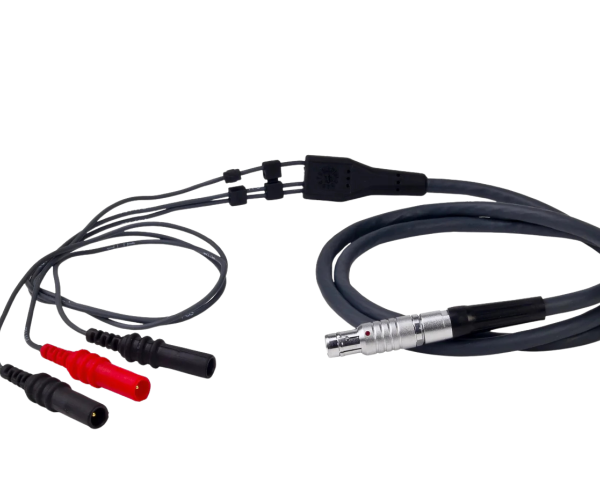
The Slow Cortical Potentials Sensor | SCP, developed by Mind Media for the NeXus ecosystem, is a professional 2-channel sensor specifically designed for the acquisition of Slow Cortical Potentials (SCP), electrical brain signals found in the lowest-frequency range of the EEG spectrum, below 1 Hz.
Slow Cortical Potentials represent very slow changes in cortical electrical activity and can vary between negative and positive shifts. Due to their characteristics, SCP acquisition requires a specialized configuration capable of recording extremely low-frequency components while maintaining careful attention to signal quality and artifact reduction.
What Are Slow Cortical Potentials?
Slow Cortical Potentials (SCPs) are very slow changes in the electrical activity of the brain.
These potentials can shift between electrically negative and positive states and are associated with changes in cortical activation and regulation.
Negative SCP shifts are generally associated with increased cortical activation and excitability, while positive shifts are associated with reduced cortical excitability or inhibition.
This makes SCPs a specific electrophysiological parameter that can be incorporated into specialized neurofeedback and neurophysiological protocols.
Signals Below 1 Hz
One of the defining characteristics of Slow Cortical Potentials is their extremely low frequency.
SCP signals are located in the EEG spectrum below 1 Hz and represent slow DC-related shifts in cortical electrical activity.
These changes may extend over hundreds of milliseconds or several seconds, making them substantially slower than conventional EEG rhythms such as alpha, beta, theta, or gamma.
The SCP measurement therefore focuses on relative slow changes in cortical potential rather than conventional EEG frequency-band activity.
Dedicated SCP Acquisition Sensor
Unlike general-purpose electrophysiological sensors, the SCP Sensor is specifically designed for Slow Cortical Potential acquisition.
This specialization enables extremely low-frequency brain activity to be incorporated into compatible NeXus systems and supports protocols that specifically require SCP measurement.
Its dedicated architecture makes it particularly suitable for professional neurofeedback, neurophysiology, psychophysiology, and research applications.
2-Channel Configuration
The Slow Cortical Potentials Sensor provides:
2 SCP acquisition channels
with signal measurement expressed in:
µV pk-pk (microvolts peak-to-peak).
The two-channel configuration allows different acquisition positions to be incorporated according to the selected protocol, training methodology, or research design.
DIN Touch Proof Connectors
The SCP Sensor uses DIN Touch Proof (TP) connectors.
This professional connection standard enables compatible electrodes to be connected to the sensor and supports electrophysiological configurations designed for Slow Cortical Potential acquisition.
Mind Media specifically associates the SCP Sensor with compatible sintered Ag/AgCl electrodes, which are suitable for recording very slow electrophysiological signals.
Sintered Ag/AgCl Electrodes
SCP measurement requires particular attention to electrode characteristics.
Compatible sintered Ag/AgCl (silver/silver chloride) electrodes can be used with the sensor to support the acquisition of slow cortical electrical changes.
Appropriate electrode selection is especially important because SCP signals occupy an extremely low-frequency range and can be sensitive to electrode characteristics, movement, and other sources of signal drift.
Shielded Cables
The SCP Sensor uses shielded cables designed to help reduce external noise and artifacts associated with cable movement.
Because Slow Cortical Potentials are very slow signals, maintaining stable acquisition conditions is particularly important.
Shielded cable construction contributes to a professional setup intended to preserve signal quality during neurofeedback and research sessions.
Noise and Motion Artifact Reduction
Electrophysiological measurements can be affected by environmental interference and movement-related artifacts.
The SCP Sensor's shielded cable construction is designed to help minimize noise and cable movement artifacts during acquisition.
This is particularly relevant for SCP protocols, where slow signal variations can potentially be influenced by unwanted movement or other low-frequency disturbances.
Sensitivity to Eye-Movement Artifacts
Slow Cortical Potentials can be particularly sensitive to artifacts produced by eye movements, especially vertical eye movements.
Electrical activity generated by the eyes and measured through EOG (Electrooculography) can interfere with the acquisition and interpretation of slow cortical signals.
For this reason, professional SCP protocols require careful attention to electrode placement, user movement, acquisition conditions, and artifact management.
SCP and Neurofeedback
Slow Cortical Potentials can be incorporated into specialized neurofeedback protocols.
Unlike conventional EEG neurofeedback that may focus primarily on frequency bands such as alpha, beta, or theta, SCP neurofeedback works with very slow shifts in cortical electrical activity.
Brain activity can be monitored and transformed into real-time feedback, allowing SCP information to be incorporated into specific brain-training methodologies.
Negative and Positive SCP Shifts
SCP measurements can reflect both negative and positive shifts in cortical electrical activity.
A negative SCP shift is generally associated with increased cortical activation and a higher excitability of underlying cortical areas.
A positive SCP shift, in contrast, is associated with reduced cortical excitability or cortical inhibition.
This relationship forms an important conceptual basis for specialized SCP neurofeedback protocols.
Ground Cable Requirement
As with other electrophysiological measurements, SCP acquisition requires an appropriate Ground (GND) connection.
A compatible Ground Cable is therefore required as part of the SCP acquisition configuration.
Only one ground connection is generally required for the electrophysiological setup, completing the electrical configuration used by the SCP Sensor and compatible NeXus system.
TP to Snap-On Cable
A TP to Snap-On Cable can also be incorporated into compatible configurations.
This adapter enables certain Snap-On electrode setups to interface with the Touch Proof connection standard used by the sensor.
This provides additional flexibility when assembling an SCP acquisition configuration using different compatible electrodes and accessories.
Compatibility with NeXus Systems
The Slow Cortical Potentials Sensor | SCP is available for compatible NeXus systems including:
- NeXus | 10;
- NeXus | Q24;
- NeXus | 4;
- NeXus | 32F.
The sensor uses an aluminum ODU connector for connection to the compatible acquisition system.
An important compatibility consideration is that the SCP Sensor is not available for the NeXus | Q32.
Professional ODU Connector
The SCP Sensor features an aluminum ODU connector designed for integration with compatible professional NeXus systems.
Combined with shielded cabling and DIN Touch Proof electrode connections, this architecture provides a dedicated configuration for professional electrophysiological acquisition.
Key Features
- Professional sensor dedicated to Slow Cortical Potentials (SCP);
- Acquisition of signals in the lowest EEG frequency range, below 1 Hz;
- 2 acquisition channels;
- SCP measurement in µV pk-pk;
- DIN Touch Proof (TP) connectors;
- Compatible with appropriate TP electrodes;
- Designed for use with sintered Ag/AgCl electrodes;
- Shielded cables;
- Designed to minimize noise and movement-related artifacts;
- Suitable for SCP neurofeedback applications;
- Suitable for low-frequency EEG and neurophysiological research;
- Requires a compatible Ground Cable;
- Can be incorporated with TP-to-Snap-On adapter configurations;
- Compatible with NeXus | 10, NeXus | Q24, NeXus | 4, and NeXus | 32F;
- Professional aluminum ODU connector;
- Not available for NeXus | Q32.
Applications
The Slow Cortical Potentials Sensor | SCP can be incorporated into applications involving:
- Slow Cortical Potentials;
- Low-frequency EEG;
- SCP Neurofeedback;
- Brain activity training;
- Neurophysiology;
- Psychophysiology;
- Scientific research;
- Cortical activity research;
- Electrophysiological acquisition;
- Professional NeXus-based protocols.
Its specialized architecture makes it particularly suitable for protocols requiring the monitoring of extremely slow changes in cortical electrical activity.
SCP as a Specialized Neurofeedback Modality
SCP-based training differs from neurofeedback approaches that primarily work with conventional EEG frequency bands.
Instead of focusing exclusively on rhythms such as alpha, beta, or theta, SCP protocols work with very slow electrical shifts in cortical activity.
Negative and positive SCP shifts provide information related to changes in cortical excitability, making Slow Cortical Potentials a distinct modality within the broader field of EEG and neurofeedback.
Professional Slow Cortical Potential Acquisition
The Slow Cortical Potentials Sensor | SCP provides a dedicated solution for professionals and researchers who need to incorporate the acquisition of slow cortical potentials below 1 Hz into compatible NeXus systems.
With 2 channels, DIN Touch Proof connectors, compatibility with sintered Ag/AgCl electrodes, shielded cables, and integration with multiple NeXus platforms, the sensor provides a specialized architecture for SCP, EEG, neurofeedback, neurophysiology, and research protocols.
Its design focused on stable low-frequency signal acquisition and artifact reduction is particularly relevant due to the extremely slow and sensitive nature of SCP signals.
Slow Cortical Potentials Sensor | SCP — professional acquisition of slow cortical potentials below 1 Hz for neurofeedback, neurophysiology, psychophysiology, and research.
Contact our team for more information about NeXus system compatibility, Ground Cable requirements, sintered Ag/AgCl electrodes, TP/Snap-On adapters, configuration, accessories, and commercial conditions.
Features
The SCP Sensor for NeXus offers:
- Slow Cortical Potentials
- DIN touch proof leads for various types of electrodes
- Shielded cables for a minimum of noise and movement-artifacts
Specifications
| ||
| ||
|