
Notice:
Values are in US Dollars for direct import by the end consumer and are subject to import duties and customs duties.
(the amount can be paid in installments or financed - (Find out here how to finance)
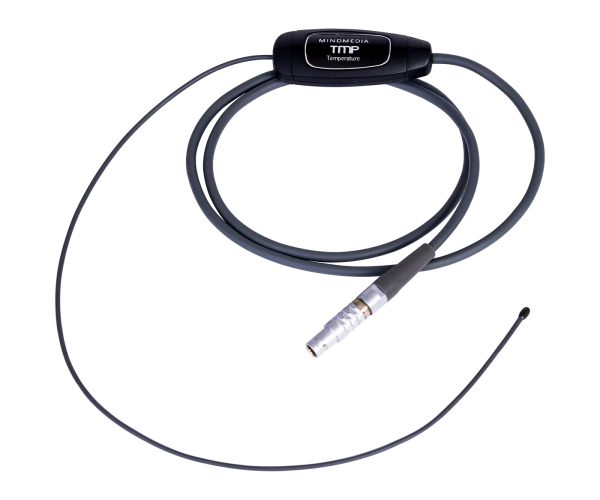
The Temperature (TMP) Sensor, developed by Mind Media for the NeXus ecosystem, is a professional sensor designed to monitor small changes in peripheral extremity temperature, providing a precise tool for biofeedback, psychophysiology, self-regulation training, human performance, and research applications.
The sensor can detect extremely subtle changes in peripheral temperature, with a sensitivity of up to 1/1000 of a degree (0.001 °C). Temperature information can be displayed in Celsius or Fahrenheit, providing flexibility for different professional protocols and environments.
Peripheral Temperature Monitoring
Peripheral temperature can change in response to variations in blood flow to the extremities.
The Temperature Sensor is specifically designed to monitor these small variations, allowing professionals to observe gradual increases or decreases in peripheral temperature throughout a session.
This physiological parameter can complement other information in biofeedback and psychophysiological assessment protocols.
Sympathetic Nervous System and Temperature
One of the main applications of peripheral temperature monitoring is observing changes associated with sympathetic nervous system activity.
According to Mind Media, situations involving stress or increased physiological arousal may cause peripheral vasoconstriction. As blood flow to the extremities decreases, the temperature measured by the sensor may also decrease.
Conversely, changes associated with relaxation may be accompanied by variations in peripheral circulation and temperature.
Temperature should therefore be considered a contextual physiological parameter rather than an isolated indicator of a specific emotional state.
High Measurement Sensitivity
One of the key advantages of the Temperature (TMP) Sensor is its high sensitivity.
The sensor can detect temperature changes as small as:
0.001 °C – 1/1000 of a degree.
This resolution makes it possible to monitor subtle variations that could go unnoticed with conventional temperature measurement systems.
In biofeedback applications, this sensitivity allows gradual temperature trends to be visualized throughout a session and helps professionals monitor how peripheral temperature responds to different exercises or conditions.
Celsius or Fahrenheit
The Temperature Sensor supports temperature information displayed in Celsius or Fahrenheit, allowing it to adapt to different professional preferences and regional requirements.
This flexibility facilitates integration into professional, educational, performance, and research protocols.
Simple Finger Placement
The sensor is designed for simple placement on the finger, making session preparation quick and practical.
According to the manufacturer, the product includes SU-MEDTAPE, which can be used to help secure the sensor appropriately during physiological acquisition.
Simple placement reduces preparation time and makes the sensor suitable for recurring biofeedback and psychophysiological monitoring sessions.
Temperature Biofeedback
Peripheral temperature can be used as a modality of biofeedback.
By observing temperature changes in real time, users can monitor how different strategies, exercises, or conditions are associated with changes in peripheral physiological responses.
This information can be incorporated into protocols designed to develop greater physiological awareness and self-regulation.
Psychophysiology and Stress Response
The Temperature Sensor can also be incorporated into psychophysiological protocols in which different physiological responses are monitored during rest, cognitive tasks, or other stimuli.
Because changes in sympathetic activity can influence peripheral circulation, extremity temperature can provide an additional physiological dimension for monitoring responses throughout a protocol.
When interpreted together with other physiological parameters, temperature can contribute to a broader understanding of changes occurring during activation and relaxation.
Multimodal Physiological Acquisition
One of the major advantages of the NeXus ecosystem is the ability to combine temperature with other physiological modalities.
Depending on the system and sensors used, professionals can integrate temperature data with signals such as:
- EEG – brain activity;
- EMG – muscle activity;
- ECG – cardiac electrical activity;
- BVP – peripheral pulse activity;
- GSR/EDA – electrodermal activity;
- RSP – respiration.
This multimodal approach allows multiple physiological responses to be monitored simultaneously and provides opportunities to analyze how they relate to each other during a session.
Temperature and Skin Conductance
Peripheral temperature can complement information obtained from Skin Conductance (GSR/EDA) measurements.
While GSR monitors electrodermal changes associated with sweat gland activity, peripheral temperature provides information related to thermal changes in the extremities.
When combined with other physiological modalities, these parameters can contribute to a more comprehensive view of psychophysiological changes during a protocol.
Compatibility with NeXus Systems
The standard version of the Temperature (TMP) Sensor uses an aluminum ODU connector and is designed for compatible systems including:
- NeXus | 10;
- NeXus | Q24;
- NeXus | 4;
- NeXus | 32F.
For the NeXus | Q32, Mind Media provides a dedicated solution called the Skin Conductance (GSR) & Temperature (TMP) Combi Sensor, featuring a black plastic ODU connector.
For this reason, it is important to select the appropriate sensor version according to the NeXus acquisition system being used.
Integration with NeXus | Q24
The Temperature Sensor is also part of the sensor ecosystem compatible with the NeXus | Q24, a platform designed for qEEG, neurofeedback, and combined physiological acquisition.
This compatibility makes it possible to add peripheral temperature to multimodal protocols performed with the Q24, complementing EEG data and other physiological signals.
Key Features
- Professional sensor for peripheral temperature monitoring;
- Monitoring of subtle temperature changes in the extremities;
- Sensitivity of up to 0.001 °C / 1/1000 of a degree;
- Temperature display in Celsius or Fahrenheit;
- Simple finger placement;
- Includes SU-MEDTAPE for attachment;
- Designed for professional physiological acquisition;
- Suitable for temperature biofeedback;
- Suitable for psychophysiological applications;
- Can support monitoring of changes associated with sympathetic activity and peripheral circulation;
- Integration into multimodal physiological protocols;
- Compatible with NeXus | 10, NeXus | Q24, NeXus | 4, and NeXus | 32F;
- Aluminum ODU connector on the standard NeXus version;
- Dedicated combined GSR + Temperature solution available for NeXus | Q32.
Applications
The Temperature (TMP) Sensor can be incorporated into applications involving:
- Temperature biofeedback;
- Self-regulation training;
- Psychophysiology;
- Physiological monitoring;
- Stress and relaxation-related protocols;
- Human performance;
- Behavioral research;
- Scientific research;
- Multimodal physiological acquisition.
Its high sensitivity allows gradual changes in peripheral temperature to be monitored throughout different stages of a protocol.
Temperature as Part of a Psychophysiological Profile
In multimodal protocols, temperature can be combined with other physiological responses to provide a more comprehensive view of the body's behavior.
Peripheral temperature can complement cardiovascular, respiratory, muscular, cerebral, and electrodermal parameters, allowing professionals and researchers to observe multiple physiological dimensions simultaneously.
This makes the TMP Sensor particularly useful when temperature needs to be incorporated into a broader psychophysiological profile rather than evaluated as an isolated parameter.
Precision for Subtle Temperature Changes
The key advantage of the Temperature (TMP) Sensor is its ability to detect extremely small thermal changes.
With a sensitivity of 1/1000 of a degree, simple finger placement, and integration with the NeXus ecosystem, the sensor provides a practical solution for professionals who want to incorporate peripheral temperature into biofeedback and psychophysiological acquisition protocols.
When combined with other NeXus sensors, it can become part of a multimodal approach that brings together multiple dimensions of physiological response within a single professional platform.
Temperature (TMP) Sensor — high sensitivity for peripheral temperature monitoring, biofeedback, and multimodal psychophysiological acquisition.
Contact our team for more information about NeXus system compatibility, sensor placement, accessories, configuration, and commercial conditions.
The Temperature Sensor for NeXus offers:
- Temperature Sensor
- Easy finger placement
- Durable quality
- Precise measurement
- SU-MEDTAPE