
Notice:
Values are in US Dollars for direct import by the end consumer and are subject to import duties and customs duties.
(the amount can be paid in installments or financed - (Find out here how to finance)
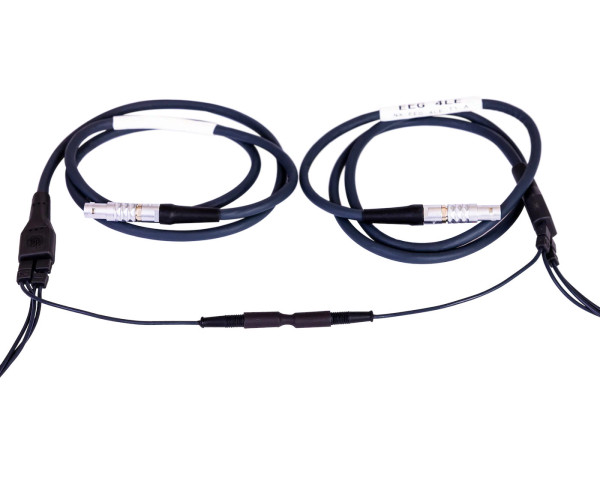
The EEG Linked Ear Sensor, developed by Mind Media for the NeXus ecosystem, is a professional solution for electroencephalography (EEG) acquisition using a linked-ear reference configuration.
Available in 2- or 4-channel EEG versions, the sensor allows simultaneous recording of brain electrical activity from multiple scalp locations while using a shared reference created through electrodes positioned at the ears or mastoids.
This architecture is particularly relevant for applications involving neurofeedback, EEG, Z-Score protocols, and methodologies that specifically require a linked-ear reference, providing a dedicated EEG acquisition configuration within the NeXus ecosystem.
EEG Acquisition with Linked-Ear Reference
The main distinguishing feature of this sensor is its true linked-ear reference configuration.
In a conventional bipolar EEG configuration, each channel may use its own reference. With Mind Media's linked-ear setup, the reference electrodes are electrically connected, creating a shared reference for the EEG channels.
According to the manufacturer, this type of configuration can be particularly suitable for selected neurofeedback applications and Z-Score library protocols that require a common linked-ear reference.
2- and 4-Channel Versions
The EEG Linked Ear Sensor is available in two primary configurations.
The 2-channel version enables acquisition of two EEG channels using a shared linked-ear reference.
The 4-channel version allows simultaneous acquisition of four EEG channels while maintaining the same common ear-reference architecture.
This flexibility allows professionals to select the configuration that best matches the channel requirements of each protocol.
4-Channel Configuration
In the four-channel version, the linked-ear cable provides four connections for EEG scalp positions and two additional connections for the ear or mastoid references.
The reference connections are electrically linked to create the common linked-ear reference shared by all four EEG channels.
This architecture provides a dedicated solution for professionals using compatible NeXus systems in 4-channel EEG and neurofeedback protocols.
Ear or Mastoid Reference Placement
The linked-ear reference can be configured using electrodes positioned on the ears or mastoid regions.
When used with ear clips, Mind Media offers compatible sets using Ag/AgCl (silver/silver chloride) electrodes.
These accessories are available in different sizes and use replaceable Ag/AgCl discs designed to provide good conductivity and support consistent EEG acquisition.
Snap-On Connections
The EEG Linked Ear Sensor uses Snap-On connectors, allowing compatible EEG electrodes to be connected quickly and conveniently.
This configuration simplifies system preparation and facilitates connection of electrodes at scalp positions and reference sites.
Snap-On compatibility also makes it easier to adapt the system to different EEG setups supported by Mind Media accessories.
Shielded Cables for Signal Quality
EEG signals are very low in amplitude, making signal quality especially important.
For this reason, the EEG Linked Ear Sensor uses shielded cables designed to reduce electrical interference and artifacts during acquisition.
The manufacturer highlights reduced 50/60 Hz interference and lower susceptibility to artifacts caused by cable movement.
These characteristics contribute to more consistent recordings during professional EEG and neurofeedback sessions.
Reduced Motion Artifacts
Cable movement can introduce unwanted artifacts into electrophysiological recordings.
The shielded design of the EEG Linked Ear Sensor helps minimize this type of interference and supports more stable EEG acquisition.
This becomes particularly important during longer neurofeedback or EEG sessions where small user movements may occur.
Reduced 50/60 Hz Interference
Electrical mains interference is a common source of noise in electrophysiological signals.
The EEG Linked Ear Sensor is designed to help minimize 50/60 Hz electrical noise, contributing to cleaner EEG acquisition.
When combined with proper electrode preparation, placement, and grounding, this can help support reliable signal quality.
Ground Cable Requirement
EEG acquisition requires a proper Ground (GND) connection.
A compatible Ground Cable should be used during EEG measurements to provide the grounding reference required by the acquisition system.
Proper ground connection, electrode preparation, and placement are important components of a stable EEG setup.
EEG Linked-Ear vs. Bipolar ExG
Mind Media offers different cable architectures for electrophysiological acquisition.
A standard bipolar ExG Sensor is a versatile solution that can be used for EMG, ECG, EOG, and EEG, with each channel having its own positive and negative connection.
The EEG Linked Ear Sensor, however, is specifically designed for EEG using a shared ear reference, where the reference connections are electrically linked.
This makes the Linked Ear Sensor especially suitable for EEG protocols that explicitly require a common linked-ear reference.
Neurofeedback
The EEG Linked Ear Sensor can be incorporated into professional neurofeedback applications.
By recording electrical brain activity from two or four channels simultaneously, the sensor enables multiple EEG positions to be integrated into compatible training protocols.
The linked-ear configuration is especially relevant for specific neurofeedback methodologies that rely on shared reference architecture.
Z-Score Applications
Mind Media identifies true linked-ear referencing as relevant for certain Z-Score applications and neurofeedback protocols.
The shared reference provides a consistent electrical reference across EEG channels, which can be important when the selected methodology specifically requires linked-ear acquisition.
For this reason, the Linked Ear Sensor provides a dedicated alternative to conventional bipolar ExG configurations.
Compatibility with NeXus Systems
The EEG Linked Ear Sensor is available in versions designed for different NeXus systems.
The standard NeXus version, featuring an aluminum ODU connector, is designed for compatible systems such as:
- NeXus | 10;
- NeXus | 4;
- NeXus | 32F.
For the NeXus | Q32, a dedicated version is available with a black plastic ODU connector.
It is important to select both the correct channel count and the appropriate connector version for the NeXus system being used.
EEG Setup Accessories
Depending on the selected configuration, additional accessories may be required for EEG acquisition.
Related components may include:
- Ground Cable;
- Ear Clip Set;
- Small Ag/AgCl EEG Discs.
These accessories support proper scalp, ear, and reference electrode placement within linked-ear EEG configurations.
Key Features
- Professional sensor dedicated to EEG acquisition;
- Linked-ear reference configuration;
- Available in 2- or 4-channel EEG versions;
- Shared reference across ear or mastoid electrodes;
- Four EEG scalp positions in the 4-channel configuration;
- Electrically linked reference connections;
- Snap-On connectors;
- Compatibility with dedicated EEG electrodes;
- Shielded cables for improved signal quality;
- Designed to reduce motion-related artifacts;
- Designed to minimize 50/60 Hz interference;
- Requires a compatible Ground Cable;
- Suitable for EEG and neurofeedback applications;
- Appropriate for protocols requiring a linked-ear reference;
- Suitable for selected Z-Score configurations;
- Versions available for different NeXus systems;
- Aluminum ODU connector on the standard NeXus version;
- Dedicated black ODU connector version available for NeXus | Q32.
Applications
The EEG Linked Ear Sensor can be incorporated into applications involving:
- EEG;
- Neurofeedback;
- 2-channel EEG;
- 4-channel EEG;
- Brain training;
- Linked-ear reference protocols;
- Compatible Z-Score applications;
- Psychophysiology;
- Scientific research;
- Neurophysiological research;
- Multimodal physiological acquisition.
Its dedicated architecture enables multiple EEG channels to use a shared ear reference, making it suitable for a wide range of professional EEG configurations.
EEG Acquisition Within the NeXus Ecosystem
When used with compatible NeXus systems, the EEG Linked Ear Sensor becomes part of a broader platform capable of combining brain activity with multiple physiological signals.
Depending on the system and configuration, EEG can be combined with modalities such as EMG, ECG, respiration, GSR/EDA, BVP, and temperature.
This enables protocols ranging from dedicated neurofeedback to broader multimodal psychophysiological acquisition.
Linked-Ear Reference for Professional EEG Acquisition
The EEG Linked Ear Sensor provides a dedicated solution for professionals who need EEG acquisition using a shared reference at the ears or mastoids.
With 2- and 4-channel versions, shielded cables, Snap-On connectors, and compatibility with multiple NeXus systems, the sensor offers a specialized architecture for EEG, neurofeedback, and protocols requiring true linked-ear reference.
The 4-channel version expands simultaneous acquisition capabilities, while the shared-reference design supports methodologies that depend on this specific EEG configuration.
EEG Linked Ear Sensors — professional 2- or 4-channel EEG acquisition with linked-ear reference, high signal quality, and integration with the NeXus ecosystem.
Contact our team for more information about 2- and 4-channel versions, NeXus system compatibility, Ground Cable, Ear Clip Set, EEG electrodes, configuration, and commercial conditions.
Features
2 or 4 channel EEG with linked ear reference
- Shielded cables for high signal quality
- No artifacts created by movement
- Free from 50/60 Hz noise
- Easy snap-on electrode connection
The EGG Sensor is provided with easy snap-on connectors fort using various types of electrodes
The 2 Channel
EEG Sensor Linked Ear can measure 2 channels of EEG with a linked ear reference.
The 4 Channel
EEG Sensor Linked Ear can measure 4 channels of EEG with a linked ear reference.