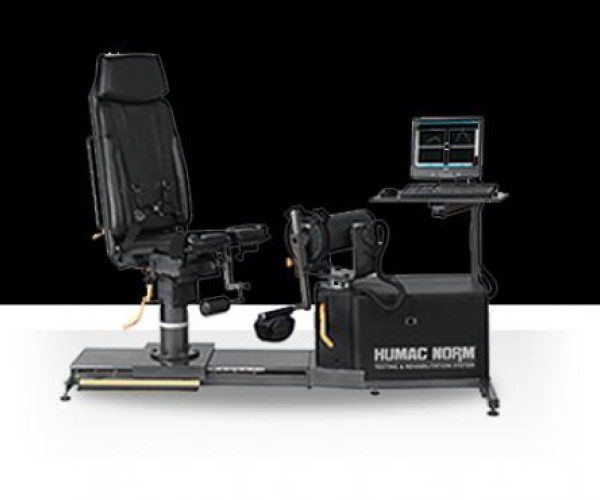
The HUMAC® NORM™ is an advanced isokinetic dynamometry system designed for objective muscle performance assessment, musculoskeletal rehabilitation, training, and scientific research.
Manufactured by Computer Sports Medicine, Inc. (CSMi), the HUMAC NORM enables professionals to quantify muscular performance and objectively monitor the progress of patients and athletes, providing valuable data to support decisions related to treatment, rehabilitation progression, and return to work or sports activities.
With support for 22 isolated movement patterns, the system enables assessment and training of multiple joints and body segments, including the shoulder, elbow, wrist, hip, knee, ankle, and spine.
Objective Muscular Performance Assessment
One of the key advantages of the HUMAC NORM is its ability to transform muscular performance into objective and reproducible data.
Dynamometry enables professionals to analyze muscular behavior during different types of contraction and compare results between limbs, sessions, and different stages of the recovery process.
According to CSMi, this information can help document the need for treatment, monitor patient progress, and provide objective data for decisions related to returning to work or sports.
Four Resistance Modes
The HUMAC NORM provides four primary resistance modes, allowing the system to be adapted to different stages of assessment and rehabilitation.
Isokinetic: enables exercise at a controlled angular velocity, including concentric and eccentric applications. It can be used for both assessment and strengthening, as well as deceleration training.
Isometric: maintains the joint at a specific position for strength assessment or training at selected joint angles.
Isotonic: uses a simulated mass mode for dynamic exercise, providing additional possibilities throughout functional progression.
Passive: moves the body segment in a controlled manner and can be incorporated into mobility and movement progression activities.
22 Movement Patterns
The HUMAC NORM includes accessories that enable professionals to perform 22 isolated movement patterns across different regions of the body.
The system supports movements involving the:
Shoulder;
Elbow;
Wrist;
Hip;
Knee;
Ankle;
Spine.
CSMi also offers optional accessories for applications such as trunk flexion/extension, work simulation, and closed kinetic chain movement patterns.
Isokinetic Assessment
In isokinetic mode, the dynamometer controls movement velocity while recording the user's muscular response.
This methodology enables standardized muscular performance assessments and provides quantitative data that can be used to monitor progress throughout rehabilitation or training.
The system supports conventional isokinetic testing, concentric/eccentric protocols, and other specific assessment configurations.
Concentric and Eccentric Training
The HUMAC NORM supports both concentric and eccentric exercise, providing greater flexibility for strengthening and functional recovery programs.
This capability allows professionals to develop specific protocols according to the objectives of each rehabilitation stage, ranging from controlled activities to more advanced exercises focused on restoring function and performance.
Passive Motion and Mobility
The passive mode expands the system's capabilities throughout different stages of the therapeutic process.
In this mode, the system can assist with developing the mobility required by the patient, from simple controlled movements to more complex movement patterns, including applications related to PNF patterns.
Proprioception and Neuromuscular Control
In addition to strength assessment, the HUMAC NORM provides capabilities for proprioceptive assessment and training.
Its protocols can be incorporated into programs designed to develop neuromuscular control, joint coordination, and functional progression.
This expands the system beyond traditional strength testing, providing additional possibilities for comprehensive rehabilitation and performance programs.
HUMAC Software and Reporting
The system uses specialized HUMAC software for managing protocols, tests, exercises, and results.
Professionals can create customized protocols consisting of different exercise sets and parameters. According to the manufacturer's documentation, a protocol can contain up to 25 sets, enabling assessment and training sessions to be structured according to individual requirements.
For clinical and scientific applications, the software also provides documentation and reporting capabilities. CSMi states that the system includes more than 30 built-in reports, providing comprehensive information for analysis and documentation.
Bilateral Comparison and Progress Monitoring
Standardized assessment protocols make it possible to compare performance between opposite sides of the body and monitor changes over time.
This information can help professionals identify bilateral deficits and track changes throughout the rehabilitation process.
Objective results can also complement clinical criteria used when determining progression and readiness to return to activity.
Key Features
Professional isokinetic dynamometry system;
Objective muscular performance assessment and training;
22 isolated movement patterns;
Assessment of the shoulder, elbow, wrist, hip, knee, ankle, and spine;
Four primary resistance modes: isokinetic, isotonic, isometric, and passive;
Concentric and eccentric assessment and exercise;
Deceleration training;
Power exercises;
Proprioceptive assessment and training;
Controlled passive motion;
Customizable protocols;
Bilateral comparisons;
Objective progress documentation;
More than 30 built-in software reports;
Optional accessories for expanded applications.
Applications
The HUMAC NORM can be incorporated into programs involving:
Physical therapy;
Orthopedic rehabilitation;
Sports medicine;
Isokinetic assessment;
Muscle strength assessment;
Sports injury rehabilitation;
Post-operative recovery;
Muscular strengthening;
Concentric and eccentric training;
Bilateral deficit assessment;
Proprioceptive training;
Neuromuscular control;
Progressive return to sports;
Return-to-work assessment;
Human performance assessment;
Scientific research and exercise science.
Designed for Clinics, Sports Centers, and Research Laboratories
The HUMAC NORM is designed to support a wide range of professional environments.
In physical therapy, it can be incorporated into different stages of orthopedic rehabilitation programs. In sports performance settings, it can support the assessment and rehabilitation of extremity injuries. In orthopedic practices, it provides objective data that can complement functional progress monitoring. In laboratories and universities, it provides reproducible measurements and documentation tools for human performance research.
Designed for Assessment and Rehabilitation
The HUMAC NORM consists of three primary components: the dynamometer, electronics module, and patient positioning chair with monorail system.
This configuration allows the user to be positioned according to the body segment and movement pattern being assessed or trained.
The system also incorporates adjustable mechanical range-of-motion stops (AMROM), designed to streamline patient setup and establish mechanical movement limits.
From Objective Assessment to Return to Function
The HUMAC NORM combines dynamometry, multiple resistance modes, specialized software, and assessment protocols to provide a comprehensive platform for muscular analysis and training.
By providing quantitative information about patient or athlete performance, the system complements clinical assessment with objective data, supports progress monitoring throughout rehabilitation, and helps establish measurable parameters for different stages of functional recovery.
For healthcare, sports performance, and research professionals, the HUMAC NORM provides an advanced solution that integrates assessment, documentation, training, and research within a single platform.
HUMAC® NORM™ — objective assessment, precision, and technology designed to transform muscular performance data into better-informed clinical and sports performance decisions.
Contact our team for more information about configurations, accessories, protocols, installation, technical requirements, and commercial conditions.
Mode
Speeds
Torque
Isokinetic Concentric
500 per sec
500 ft-lbs / 678 Nm
Isokinetic Eccentric
500 per sec
500 ft-lbs / 678 Nm
CPM
500 per sec
500 ft-lbs / 678 Nm
Isometric
500 ft-lbs / 678 Nm
Isotonic
500 ft-lbs / 678 Nm
POWER REQUIREMENTS
Input Voltage
220 VAC (other voltages available)
Input Frequency
60Hz (international frequency 50Hz available)
Independent
20 amp dedicated circuit required
Manufacturing
HUMAC NORM Systems are manufactured just outside Boston in Stoughton, Massachusetts, USA. The HUMAC NORM consists of four component groups – metal fabrication, computer, electronics, and software. The manufacturing process is performed under our ISO9001 Certification Process.
Metal fabrication (cut, weld, and paint) is performed by a nearby specialty custom fabrication facility. Computers are supplied by DELL Computers, the world leader in small computer systems. Custom circuit boards are designed in-house and manufactured by a nearby fabrication house. Lastly our HUMAC Software is developed and produced in-house.
The HUMAC NORM components are gathered at our corporate facility for final assembly, testing, and packaging. We ship HUMACs worldwide, with customers throughout the US, Great Britain, and elsewhere.
Regulatory Approvals
CENELEC EN 60601-1-2 – 2001 – Medical Electrical Equipment Part 1-2: General Requirements for Safety – Collateral Standard: Electromagnetic Compatibility – Requirements and Tests IEC 60601-1-2: 2001.
CENELEC EN 60601-1 – Medical Electrical Equipment Part 1: General Requirements for Safety Incorporates Corrigendum July 1994; Includes Amendments A1: 1993, A11: 1993, A12: 1993, A2: 1995 and A13: 1996; IEC 601-1: 1988 + A1: 1991 + A2: 1995 + Corrigendum 1995, Modified.
UL 60601-1 – UL Standard for Safety Medical Electrical Equipment, Part 1: General Requirements for Safety First Edition.
CSA C22.2 NO 601.1-M90 – Medical Electrical Equipment – Part 1: General Requirements for Safety General Instruction No 1; Supplement 1; 1994 R(1997).
IEC 60601-1-1 (1992-01) – Medical Electrical Equipment Part 1: General Requirements for Safety 1. Collateral Standard: Safety Requirements for Medical Electrical Systems First Edition.
IEC 60601-1 – Medical Electrical Equipment Part 1: General Requirements for Safety Second Edition.
CSMi Quality Certification
ISO 9001:1994 and ISO 13485:1196 with CMDCAS.
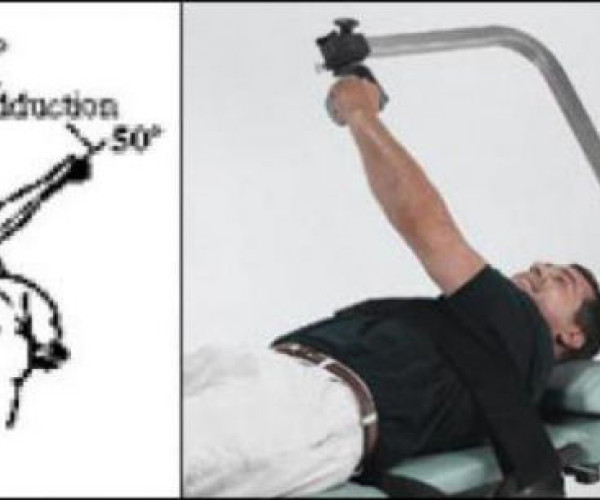
SHOULDER: ABDUCTION / ADDUCTION
Axis of Rotation:
The instantaneous axis of rotation changes throughout the movement. The compromise axis is medial to the acromion process when the limb is in the neutral position.
Parts Needed:
Elbow/Shoulder Adapter
Footrest
Lumbar Cushion
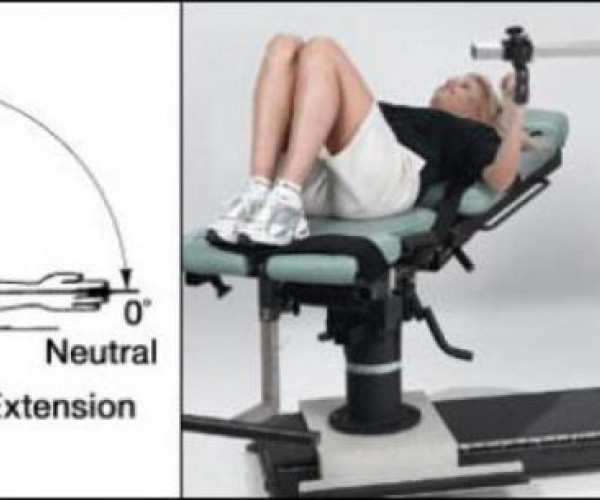
SHOULDER: EXTENSION / FLEXION
Axis of Rotation:
The instantaneous axis of rotation changes throughout the movement. The compromise axis is medial to the acromion process when the limb is in the neutral position.
Parts Needed:
Elbow/Shoulder Adapter
Footrest
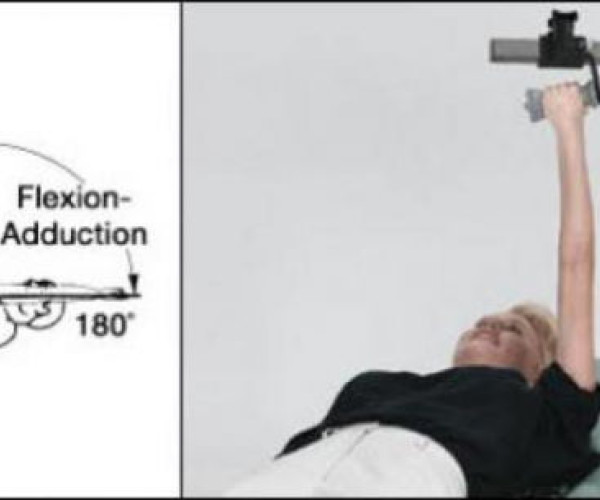
SHOULDER: HORIZONTAL ABDUCTION / ADDUCTION
Axis of Rotation:
The instantaneous axis of rotation changes throughout the movement. The compromise axis is medial to the acromion process when the limb is in 90° horizontal abduction.
Parts Needed:
Elbow/Shoulder Adapter
Footrest
Torso Belt
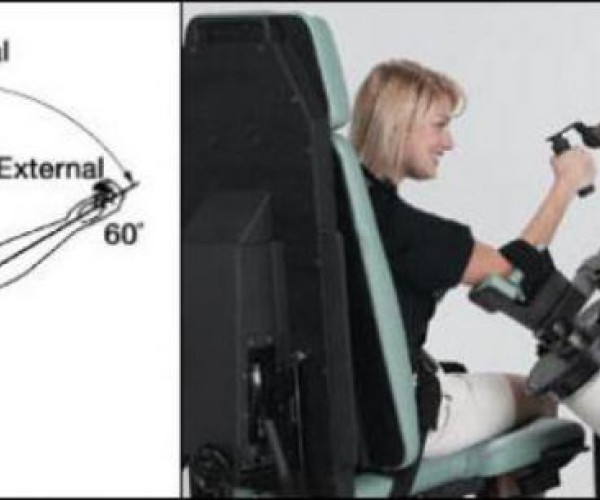
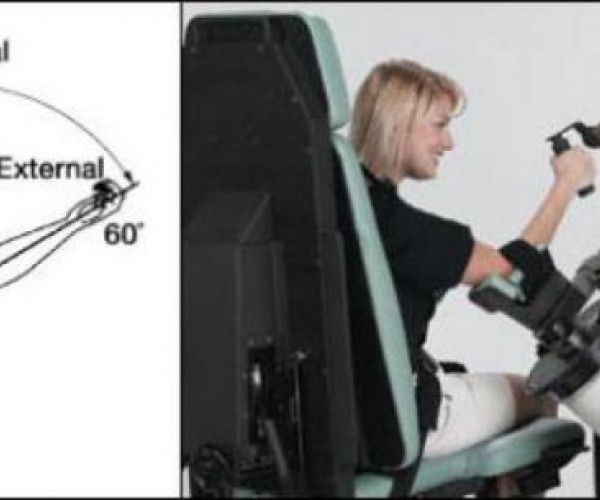
SHOULDER: INTERNAL / EXTERNAL ROTATION IN 90° ABDUCTION
Axis of Rotation:
The instantaneous axis of rotation changes throughout the movement. The compromise axis is medial to the acromion process when the limb is in 90° horizontal abduction.
Parts Needed:
Elbow/Shoulder Adapter
Footrest
Torso Belt
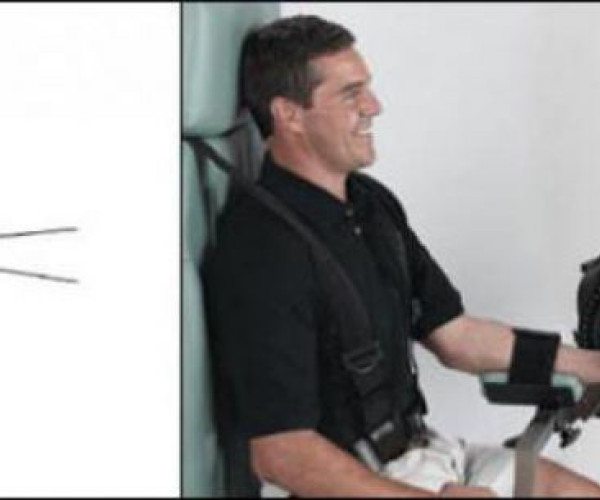
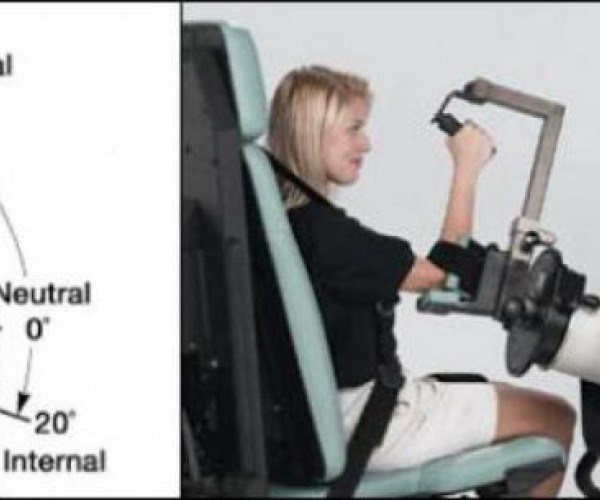
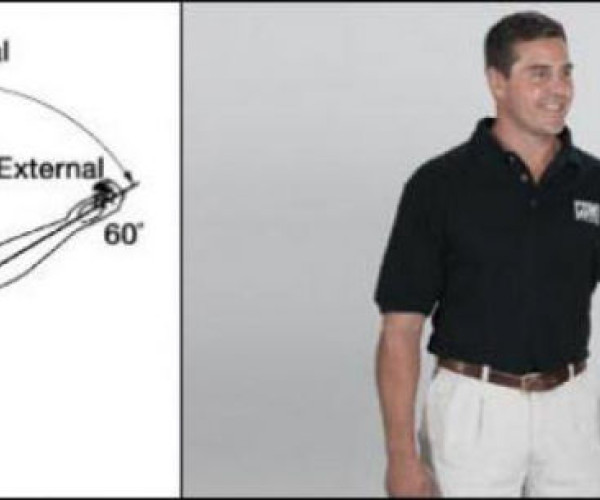
SHOULDER: INTERNAL / EXTERNAL ROTATION, MOD STANDING
Axis of Rotation:
The axis of rotation is the longitudinal axis of the humerus.
Parts Needed:
Wrist/Shoulder Adapter
Elbow Stabilizer Pad
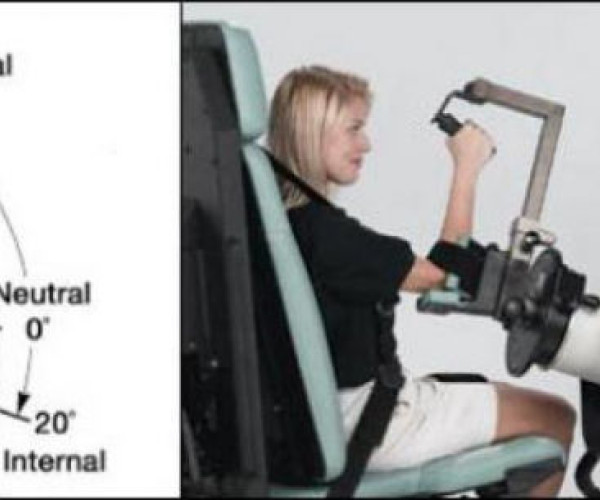
SHOULDER: INTERNAL / EXTERNAL ROTATION, MOD SEATED
Axis of Rotation:
The axis of rotation is the longitudinal axis of the humerus.
Parts Needed:
Wrist/Shoulder Adapter
Elbow Stabilizer Pad
Lumbar Cushion
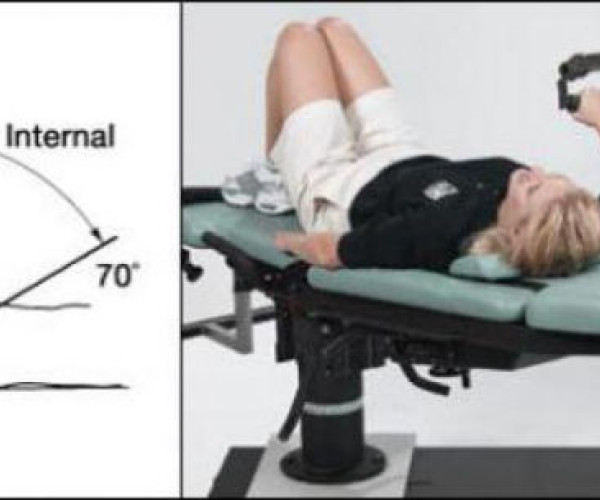
SHOULDER: INTERNAL / EXTERNAL ROTATION IN 90° FLEXION
Axis of Rotation:
The axis of rotation is the longitudinal axis of the humerus. If length adjustment of wrist / shoulder adapter is correct, and elbow flexed at 90° with forearm parallel to input arm, the axis alignment will be established and maintained by the Elbow Stabilization Pad.
The instantaneous axis of rotation changes throughout the movement. The compromise axis is medial to the acromion process when the limb is in the neutral position. The motion for this pattern begins in full Extension-Abduction and moves to full Flexion-Adduction, the limb should be supinated and externally rotated.
Parts Needed:
Elbow/Shoulder
Adapter Footrest
ELBOW: EXTENSION / FLEXION
Axis of Rotation:
The axis of rotation is immediately distal to the lateral epicondyle and moves only slightly anteriorly as flexion increases.
Parts Needed:
Elbow/Shoulder Adapter
Footrest
Lumbar Cushion
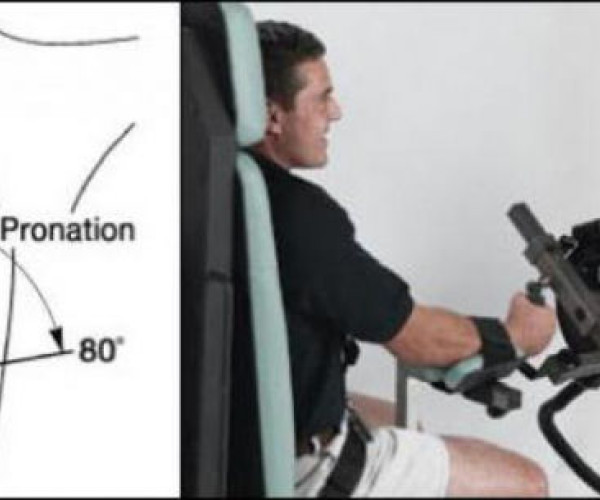
WRIST / FOREARM: PRONATION / SUPINATION
Axis of Rotation:
The axis of rotation bisects the head of the ulna distally and the head of the radius proximally. It is established by placing the forearm directly in line with the dot on the dynamometer input tube at approximately the level of the ring finger.
Parts Needed:
Thigh/Forearm Stabilizer Tube
Forearm Stabilizer V-Pad
Wrist/Shoulder Adapter
Lumbar Cushion
Counterbalance Weight
WRIST: EXTENSION / FLEXION
Axis of Rotation:
This axis alignment is critical and somewhat difficult in the pattern. The axis of rotation is slightly oblique passing through the wrist just distal to the tubercle of the radius and the head of the ulna (approximately where the hand meets the wrist).
Parts Needed:
Thigh/Forearm Stabilizer Tube
Forearm Stabilizer V-pad
Wrist/Shoulder Adapter
Lumbar Cushion
WRIST: RADIAL / ULNAR DEVIATION
Axis of Rotation:
The axis of rotation is located approximately at the center of the capitate bone. This is found at the middle of the wrist just distal to the axis for extension/flexion.
Parts Needed:
Thigh/Forearm Stabilizer Tube
Forearm Stabilizer V-pad
Wrist/Shoulder Adapter
Lumbar Cushion
HIP: ABDUCTION / ADDUCTION
Axis of Rotation:
The axis of rotation is superior and medial to the greater trochanter.
Parts Needed:
Knee/Hip Adapter
Knee/Hip Pad
HIP: FLEXION / EXTENSION
Axis of Rotation:
The axis of rotation is slightly anterior in extreme flexion as the pelvis tilts to increase range of motion. The normal movement synergy does not affect testing accuracy.
Parts Needed:
Knee/Hip Adapter
Knee/Hip Pad
Footrest
HIP: INTERNAL / EXTERNAL ROTATION
Axis of Rotation:
The axis of rotation is a mechanical axis of the femur (line through centers of hip and knee joints). This can be visualized, approximated and then fine adjusted during warm up/familiarization repetitions.
Parts Needed:
Ankle Adapter
Footplates
Footrest
KNEE: EXTENSION / FLEXION SEATED
Axis of Rotation:
The most accurate fixed axis for rehab or testing of the knee is a line passing transversely through the femoral condyles.
Parts Needed:
Contralateral Limb Stabilizer
Knee/Hip Adapter
Knee/Hip Pad
Lumbar Cushion
KNEE: EXTENSION / FLEXION PRONE
Axis of Rotation:
The most accurate fixed axis for rehab or testing of the knee is a line passing transversely through the femoral condyles.
Parts Needed:
Knee/Hip Adapter
Knee/Hip Pad
KNEE: TIBIAL INTERNAL / EXTERNAL ROTATION
Axis of Rotation:
The axis of rotation is slightly medial to the longitudinal axis of the tibia. This can be visualized, approximated and then fine adjusted during warm up/familiarization repetitions.
Parts Needed:
Ankle Adapter
Footplates
Thigh Stabilizer Pad
Thigh/Forearm Stabilizer Tube
Footrest
ANKLE: PLANTAR / DORSIFLEXION PRONE
Axis of Rotation:
The axis of rotation passes obliquely (approximately 16° anteromedially) through the tip of the fibula (lateral malleous) and the trochlea of the talus, exiting just distal to the tip of the tibia (medial malleous).
Parts Needed:
Ankle Adapter
Footplates
ANKLE: PLANTAR / DORSIFLEXION SUPINE
Axis of Rotation:
The axis of rotation passes obliquely (approximately 16° anteromedially) through the tip of the fibula (lateral malleous) and the trochlea of the talus, exiting just distal to the tip of the tibia (medial malleous).
Parts Needed:
Ankle Adapter
Footplates
Footrest
Thigh Stabilizer Pad
Thigh/Forearm Stabilizer
Counterbalance Weight
ANKLE: INVERSION / EVERSION
Axis of Rotation:
The axis is compound and changes throughout range of motion of the talo-crural joint, talocalcaneal joint and talonavicular/ calcanecuboid or transverse tarsal joint.