
Notice:
Values are in US Dollars for direct import by the end consumer and are subject to import duties and customs duties.
(the amount can be paid in installments or financed - (Find out here how to finance)
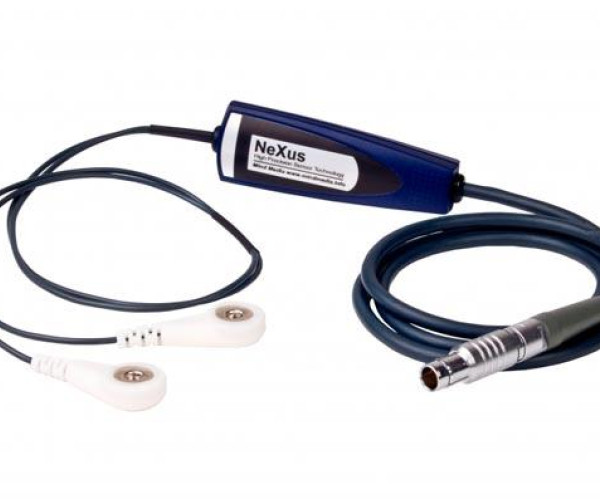
The Skin Conductance (GSR) Sensor, developed by Mind Media for the NeXus ecosystem, is a professional sensor designed to measure the electrical conductance of the skin, a physiological parameter also known as Galvanic Skin Response (GSR) or Electrodermal Activity (EDA).
The sensor measures small changes in sweat gland activity through electrodes positioned on the fingers or palm of the hand. Because sweating is controlled by the sympathetic nervous system, changes in skin conductance can provide information related to the level of physiological and psychological arousal during different stimuli, tasks, or states of relaxation.
This makes the GSR Sensor particularly suitable for applications involving biofeedback, psychophysiology, human performance training, research, and multimodal physiological acquisition.
Skin Conductance, GSR, and EDA
Skin Conductance (SC) represents the ability of the skin to conduct a small electrical current. This property varies according to sweat gland activity.
The same physiological response may be referred to using different terms, including:
- SC – Skin Conductance;
- GSR – Galvanic Skin Response;
- EDA – Electrodermal Activity.
The Skin Conductance Sensor is specifically designed to record these changes and convert them into data that can be monitored using compatible NeXus systems.
Sweat Gland Activity
The sensor measures sweat gland activity on the fingers or palm of the hand.
During situations associated with increased physiological activation, sweating may increase, which can also increase the electrical conductance of the skin. During relaxation, skin conductance generally tends to decrease and typically shows less variability.
These changes make electrodermal activity a valuable physiological parameter for monitoring how the body responds to different conditions and stimuli.
Phasic and Tonic Responses
Electrodermal activity can present different patterns of change.
A response occurring in association with a specific stimulus is referred to as a phasic change. This represents a relatively rapid change in skin conductance associated with the body's response to an event or stimulus.
Slower, more gradual changes in skin conductance are known as tonic changes, representing longer-term trends in the overall skin conductance level.
The ability to observe both types of responses expands the usefulness of the sensor in biofeedback, psychophysiology, and research protocols.
Measurement in MicroSiemens
Skin conductance is measured in microSiemens (µS).
The Skin Conductance (GSR) Sensor provides a measurement range of:
0.1 to 1000 µS
with a resolution of:
0.001 µS.
According to the manufacturer, the sensor is designed to detect very small relative changes associated with sweat gland activity, providing the sensitivity required for professional electrodermal acquisition applications.
Reusable Ag/AgCl Electrodes
The GSR Sensor is supplied with Ag/AgCl electrodes featuring Velcro straps and Snap-On connections.
These electrodes are typically positioned on the fingers of the non-dominant hand and can be adjusted to accommodate different finger sizes.
According to Mind Media, the electrodes can be reused more than 100 times, providing a practical solution for recurring physiological acquisition and biofeedback sessions.
Simple Finger Placement
The system uses adjustable Velcro straps to facilitate electrode placement.
This configuration provides several practical advantages, including adaptation to different finger sizes, quick placement, easy removal, and electrode reusability.
The Snap-On connection also simplifies the connection between the electrodes and sensor during session preparation.
Skin Conductance Biofeedback
Skin conductance is widely used as a physiological parameter in biofeedback protocols.
By monitoring changes in GSR/EDA throughout a session, professionals can observe variations in physiological activation associated with stimuli, cognitive tasks, emotional responses, or periods of relaxation.
The sensor converts these electrodermal changes into measurable signals that can be integrated into the physiological acquisition environment of compatible NeXus systems.
Physiological and Psychological Arousal
One of the primary applications of electrodermal activity is monitoring changes related to arousal.
Sweat gland activity is controlled by the sympathetic nervous system and is closely related to the body's level of physiological activation.
During periods of increased activation, skin conductance and its variability may increase. During relaxation, conductance generally decreases and tends to show less variability.
It is important to note that GSR alone does not identify a specific emotion. Instead, it indicates changes in physiological arousal and should be interpreted according to the context of the protocol and other available information.
Psychophysiology and Research
The ability to record electrodermal responses makes the GSR Sensor particularly useful for psychophysiology and behavioral research.
The signal can be used to observe physiological changes associated with different stimuli and tasks, particularly when combined with other parameters in a multimodal configuration.
Depending on the NeXus system being used, skin conductance can be analyzed alongside signals such as EEG, EMG, ECG, BVP, respiration, and temperature.
Multimodal Physiological Acquisition
One of the major advantages of the NeXus ecosystem is the ability to combine different physiological modalities within the same session.
The GSR Sensor can complement sensors used for:
- EEG – brain activity;
- EMG – muscle activity;
- ECG/BVP – cardiovascular information;
- RSP – respiration;
- TMP – temperature.
This approach allows multiple dimensions of the user's physiological response to be monitored simultaneously.
Compatibility with NeXus Systems
The standard version of the Skin Conductance Sensor, equipped with an aluminum ODU connector, is designed for compatible NeXus systems including:
- NeXus | 10;
- NeXus | 4;
- NeXus | 32F.
For the NeXus | Q32, Mind Media provides a dedicated sensor that combines Skin Conductance + Temperature and uses a black plastic ODU connector.
For this reason, the appropriate sensor version should always be selected according to the NeXus acquisition system being used.
Key Features
- Professional sensor for SC/GSR/EDA measurement;
- Measurement of electrodermal activity;
- Measurement range of 0.1 to 1000 µS;
- Resolution of 0.001 µS;
- Detection of sweat gland activity on the fingers or palm;
- Monitoring of phasic and tonic electrodermal changes;
- Reusable Ag/AgCl electrodes;
- Adjustable Velcro finger straps;
- Snap-On electrode connections;
- Electrodes reusable for more than 100 sessions, according to the manufacturer;
- Suitable for biofeedback and psychophysiological applications;
- Integration with compatible NeXus systems;
- Dedicated Skin Conductance + Temperature configuration available for the NeXus | Q32;
- Suitable for multimodal physiological acquisition.
Applications
The Skin Conductance (GSR) Sensor can be incorporated into applications involving:
- Biofeedback;
- Skin conductance training;
- GSR/EDA monitoring;
- Psychophysiology;
- Physiological arousal monitoring;
- Self-regulation training;
- Human performance;
- Behavioral research;
- Scientific research;
- Multimodal physiological acquisition.
Its ability to record small changes in skin conductance also allows electrodermal responses to be correlated with other physiological signals acquired simultaneously.
Sensitivity to Small Physiological Changes
With a resolution of 0.001 µS, the GSR Sensor is designed to detect very small changes in skin conductance.
This sensitivity is particularly valuable for observing electrodermal responses that may occur following specific stimuli or changes in physiological activation.
Throughout a session, professionals and researchers can monitor both rapid responses associated with individual events and slower trends in overall skin conductance.
A Practical Tool for Understanding Electrodermal Responses
The Skin Conductance (GSR) Sensor provides a practical and sensitive way to incorporate electrodermal activity into the NeXus ecosystem.
By measuring changes in skin conductance associated with sweat gland activity, the sensor provides an objective physiological parameter for monitoring changes in arousal, complementing biofeedback and psychophysiological protocols.
When combined with other sensors from the NeXus ecosystem, GSR expands the possibilities for multimodal analysis, allowing electrodermal responses to be correlated with multiple aspects of human physiology.
Skin Conductance (GSR) Sensor — high-sensitivity electrodermal activity monitoring for biofeedback, psychophysiology, and multimodal physiological acquisition.
Contact our team for more information about available versions, electrodes, NeXus system compatibility, configuration, accessories, and commercial conditions.
The GSR Sensor for NeXus offers:
- Skin Conductance Sensor
- For the Q32 the combined Skin Conductance / Temperature Sensor
- Adjustable velcro straps for every size finger
- Easy snap-on leads
Specifications
| |
| |
|